We use cookies to make your experience better.
To comply with the new e-Privacy directive, you agree to the privacy policy and our use of cookies.

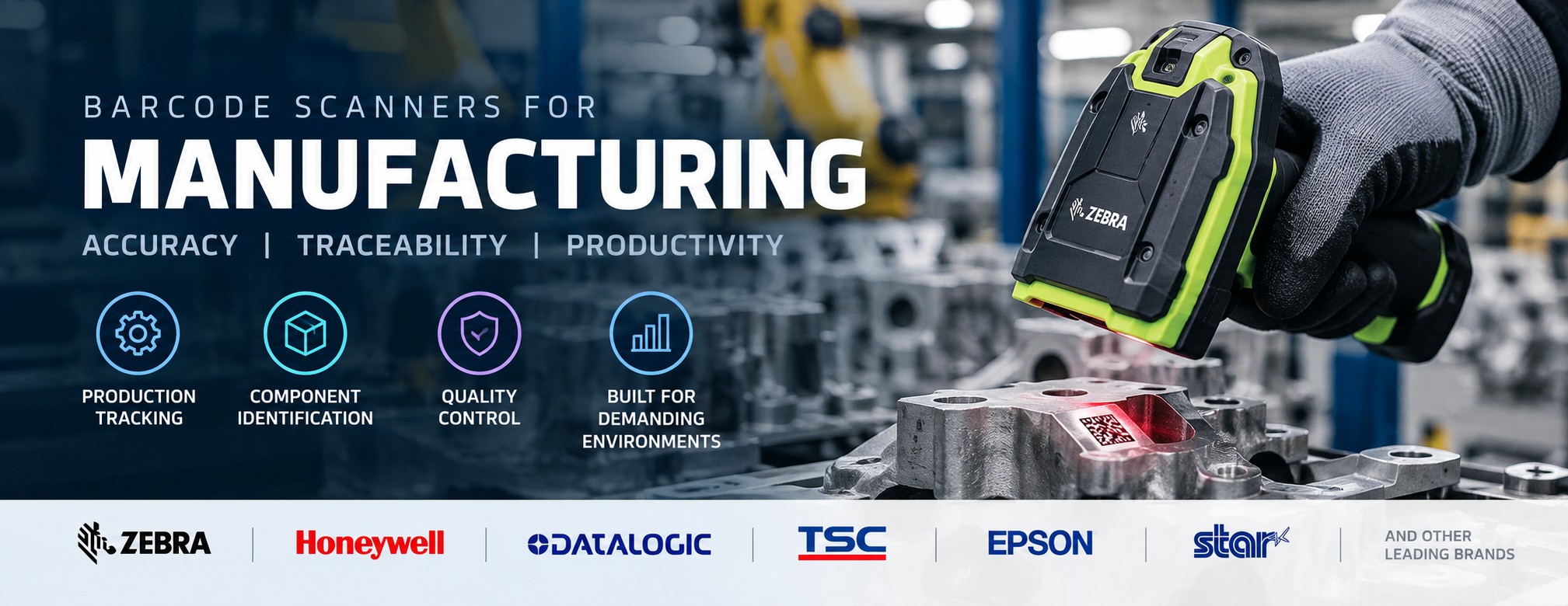
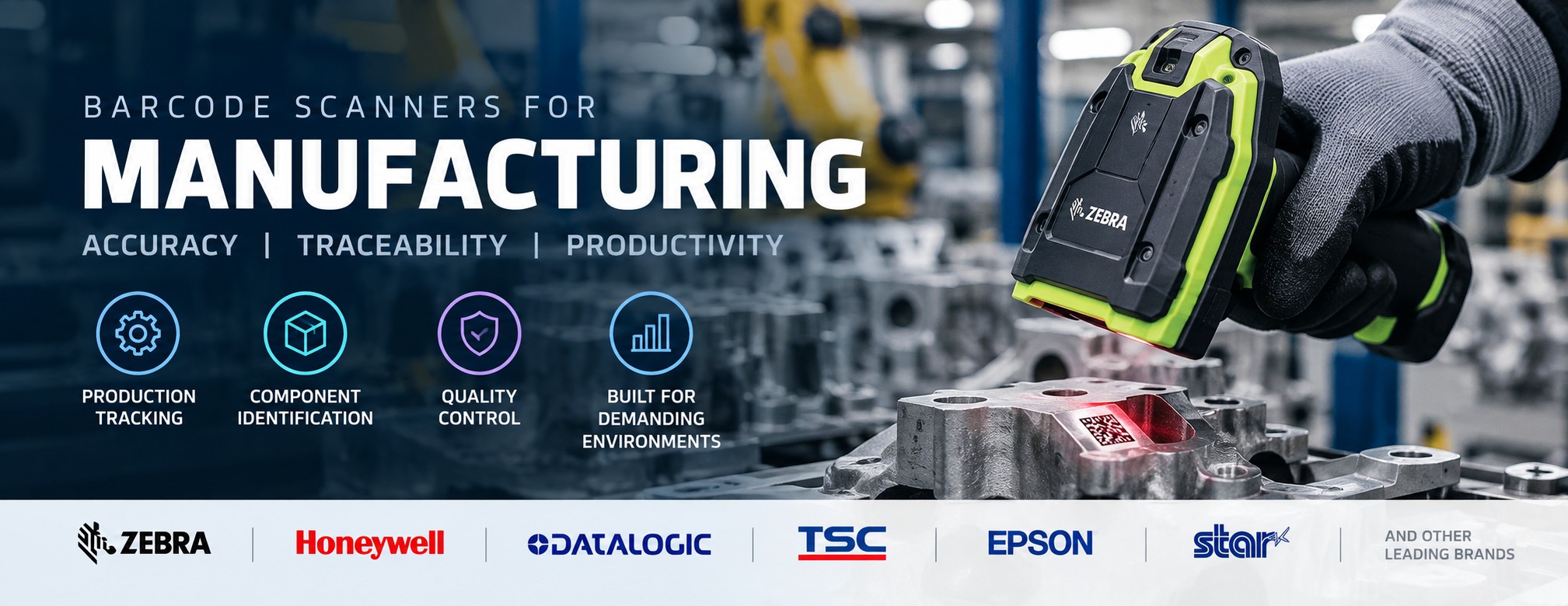
Barcode Scanners for Manufacturing
Tek Direkt supplies barcode scanners for manufacturing, production and industrial environments, helping businesses capture barcode data throughout production, inventory, quality-control and traceability processes.
From general-purpose handheld scanners used at production workstations to rugged industrial barcode scanners designed for demanding factory environments, we supply solutions from Zebra, Honeywell, Datalogic and other leading manufacturers.
Manufacturing applications can also require specialist scanning technology for damaged or difficult barcodes, long-range identification and Direct Part Marking (DPM) on components and manufactured parts.
If you already know the scanner or configuration you require, send us the manufacturer part number (MPN) and quantity for a business quote.
Barcode Scanning in Manufacturing
Barcode scanning can provide fast and accurate identification throughout the manufacturing process.
Rather than relying on manual data entry, operators can scan products, components, materials and production documentation as they move through different stages of an operation.
Typical manufacturing barcode scanning applications include:
- Raw material identification
- Component tracking
- Work-in-progress (WIP)
- Production tracking
- Inventory and stock control
- Quality-control processes
- Assembly verification
- Finished-goods identification
- Packing and dispatch
- Asset tracking
- Product traceability
- Direct Part Marking
The right scanner depends on the barcode being captured, the scanning distance and the physical environment in which the equipment will be used.
Choosing a Barcode Scanner for Manufacturing
A scanner used at a clean production workstation may have very different requirements from one used on a factory floor or around heavy industrial equipment.
Before choosing a manufacturing barcode scanner, consider:
- Barcode type – 1D, 2D or both
- Barcode material – paper labels, plastic, metal or directly marked components
- Barcode condition – clean, damaged, dirty or low contrast
- Scanning distance – close-range component scanning or longer-range identification
- Environment – clean production area or demanding industrial environment
- Ruggedness – resistance to drops, knocks, dust and other working conditions
- Corded or cordless operation
- DPM requirements – whether codes are printed on labels or marked directly onto parts
- Host device – workstation, PC, industrial terminal or mobile computer
The complete manufacturer part number is particularly important when purchasing industrial scanners because scanners within the same product family can use different scan engines and configurations.
Rugged Barcode Scanners for Manufacturing
Manufacturing environments can be demanding on scanning equipment.
Repeated drops, knocks, dust and intensive use can make a rugged industrial scanner more appropriate than a conventional general-purpose barcode scanner.
Zebra's DS3600 Series is designed for demanding industrial applications, with corded and cordless configurations available for manufacturing, warehouse and logistics operations.
Rugged scanners can be particularly useful for:
- Factory floors
- Production lines
- Assembly areas
- Goods-in
- Raw-material storage
- Finished-goods areas
- Industrial warehouses
- Loading and dispatch areas
Where the working environment is likely to expose equipment to regular impacts or harsh conditions, check the scanner's environmental protection and drop specifications before ordering.
Direct Part Marking (DPM) Barcode Scanners
Some manufacturing applications require barcodes to remain associated with a component throughout its working life.
Rather than applying a conventional printed label, manufacturers can use Direct Part Marking (DPM) to create a permanent machine-readable code directly on a component.
Methods can include:
- Laser marking
- Dot-peen marking
- Chemical etching
- Engraving
- Other permanent marking processes
DPM codes are widely associated with applications where component identification and traceability are important.
Reading these marks can be more challenging than scanning a conventional barcode label because the code may have low contrast, an uneven surface or different lighting characteristics.
A specialist DPM barcode scanner is therefore normally required.
Tek Direkt supplies DPM-capable scanners from manufacturers including Zebra, Honeywell and Datalogic for industrial identification and traceability applications.
Browse Direct Part Marking (DPM) Barcode Scanners →
Manufacturing Traceability
Barcode scanning can support traceability by providing a reliable way to identify materials, components and finished products as they move through production.
Depending on the systems used by the business, barcode data can form part of processes recording:
- Material receipt
- Batch or lot identification
- Component usage
- Production stages
- Assembly
- Inspection
- Quality control
- Finished products
- Packing
- Dispatch
Where individual components need permanent identification, DPM can extend traceability beyond conventional adhesive labels.
The barcode scanner itself is only one part of a traceability system, so compatibility with the software, barcode format and existing hardware should always be checked before deployment.
RFID can also form part of manufacturing traceability where businesses need to identify tagged components, tools, assets or work-in-progress without individually presenting each item to a barcode scanner. See our RFID Readers & Scanners for Business page for handheld and fixed RFID options.
Scanning Damaged, Dirty and Difficult Barcodes
Barcodes used in industrial environments are not always presented in ideal conditions.
Printed labels can become dirty, scratched or damaged, while codes printed on challenging surfaces may offer less contrast than conventional retail or shipping labels.
Higher-performance industrial scanners are designed to provide more dependable barcode capture in these situations.
If difficult barcodes are a regular part of your operation, scanner selection should be based on the actual barcode and environment, rather than simply choosing a scanner because it supports the required barcode symbology.
For particularly challenging applications, testing the scanner against representative samples before a larger deployment can be worthwhile.
Corded or Cordless Manufacturing Barcode Scanners?
Both corded and cordless scanners can be suitable for manufacturing.
Corded Barcode Scanners
A corded scanner can be a good choice for a fixed production or inspection workstation.
Benefits include:
- Continuous connection to the host
- No scanner battery to manage
- Simple workstation deployment
- Suitable for repetitive scanning at a defined location
Models such as the Zebra DS3608 provide rugged scanning in a corded industrial format.
Cordless Barcode Scanners
Cordless scanners give operators greater freedom to move around components, containers, pallets and production areas.
They can be useful where the item being scanned cannot easily be brought to a fixed workstation or where operators need to move within a defined working area.
When selecting a cordless scanner, consider wireless range, battery requirements and the charging arrangement as part of the deployment.
Standard-Range and Extended-Range Scanning
Most component and product identification takes place at relatively close range, but some manufacturing and industrial applications require barcodes to be captured from further away.
This can include labels on:
- Pallets
- Racking
- Large components
- Containers
- Materials stored above ground level
Scanner families can be available with different standard-range and extended-range scan engines, so don't assume every scanner carrying the same family name provides the same scanning distance.
Always check the complete manufacturer part number when comparing specifications and supplier quotations.
Barcode Scanners vs Mobile Computers in Manufacturing
A dedicated barcode scanner is ideal where an operator primarily needs to capture barcode data and send it to a connected workstation or system.
For workflows requiring workers to move throughout a facility while also accessing software and information, a mobile computer may be more appropriate.
Mobile computers combine barcode scanning with a screen, operating system and wireless connectivity, allowing workers to scan items and interact directly with inventory, production or other business applications.
Some manufacturing operations use both:
Barcode scanners at fixed production and inspection stations.
Mobile computers for stock movement, replenishment, inventory and mobile production workflows.
Browse Mobile Computers →
Learn about Label Printers for Manufacturing →
Barcode Scanners for Production Workstations
Not every manufacturing environment requires an ultra-rugged scanner.
For clean production, packing, inspection and administrative workstations, a conventional handheld 2D barcode scanner may provide the required performance at a lower cost.
The important consideration is matching the scanner to the application rather than automatically specifying industrial hardware everywhere.
Where operators scan standard printed 1D and 2D labels at close range, a general-purpose scanner may be sufficient.
Where scanners are exposed to harsher conditions, difficult codes or repeated drops, moving to rugged industrial hardware becomes more appropriate.
Manufacturing Barcode Scanner Brands
Tek Direkt supplies barcode scanning equipment from leading Auto-ID manufacturers.
Zebra Manufacturing Barcode Scanners
Zebra Technologies offers general-purpose, high-performance and rugged industrial barcode scanners, including specialist configurations for demanding manufacturing and DPM applications.
The Zebra DS3600 Series is particularly relevant to industrial environments, while other Zebra scanner families can suit production workstations and lighter-duty applications.
Honeywell Manufacturing Barcode Scanners
Honeywell supplies barcode scanning hardware for industrial, warehouse, manufacturing and general business applications, including rugged and specialist scanning solutions.
Datalogic Manufacturing Barcode Scanners
Datalogic provides handheld and industrial barcode scanning technology for manufacturing, logistics, warehousing and automated identification applications.
Manufacturing and Warehouse Barcode Scanning
Manufacturing and warehouse scanning requirements frequently overlap, particularly around goods-in, inventory, picking, finished goods and dispatch.
The main difference is that manufacturing can introduce additional requirements around production tracking, component identification, quality control and DPM traceability.
If your requirement is primarily warehouse based, read our Warehouse Barcode Scanners page for more information on scanners for stock control, picking, packing and warehouse operations.
You can also read our Best Barcode Scanner for Warehouse Guide for additional buying guidance.
Buy Barcode Scanners for Manufacturing
Tek Direkt supplies barcode scanners for manufacturing, production and industrial applications to businesses across the UK.
Browse our barcode scanner range for handheld, cordless, rugged and specialist barcode scanning hardware from leading manufacturers.
For demanding industrial applications, consider rugged scanners designed to withstand the conditions found on factory floors and production sites.
If you need to capture codes permanently marked onto components, choose a scanner specifically designed for Direct Part Marking (DPM) rather than assuming a standard 2D scanner will reliably read them.
Already know what you need?
Send us the manufacturer part number (MPN) and quantity and we'll provide a business quote. If you already have a supplier quotation, send us the exact MPN and quantity for another price to compare.

