

GUIDED SCANNER FINDER
What do you need your scanner to do?
1. Where will you use it?
2. What type of barcode?
3. Your requirements
Select your requirements to find suitable barcode scanners.
YOUR RECOMMENDATIONS
Suggested barcode scanners
Need help choosing a barcode scanner?
Tell us what you're scanning, the distance, your working environment and whether you need wired or cordless operation.
We can help you identify suitable barcode scanners and accessories.
Ask Tek Direkt →How to choose the right barcode scanner
Choosing a barcode scanner depends on the types of barcodes you need to read, where scanning takes place and how the equipment will be used. A scanner suitable for a retail checkout may not be appropriate for a warehouse, production line or direct part marking application.
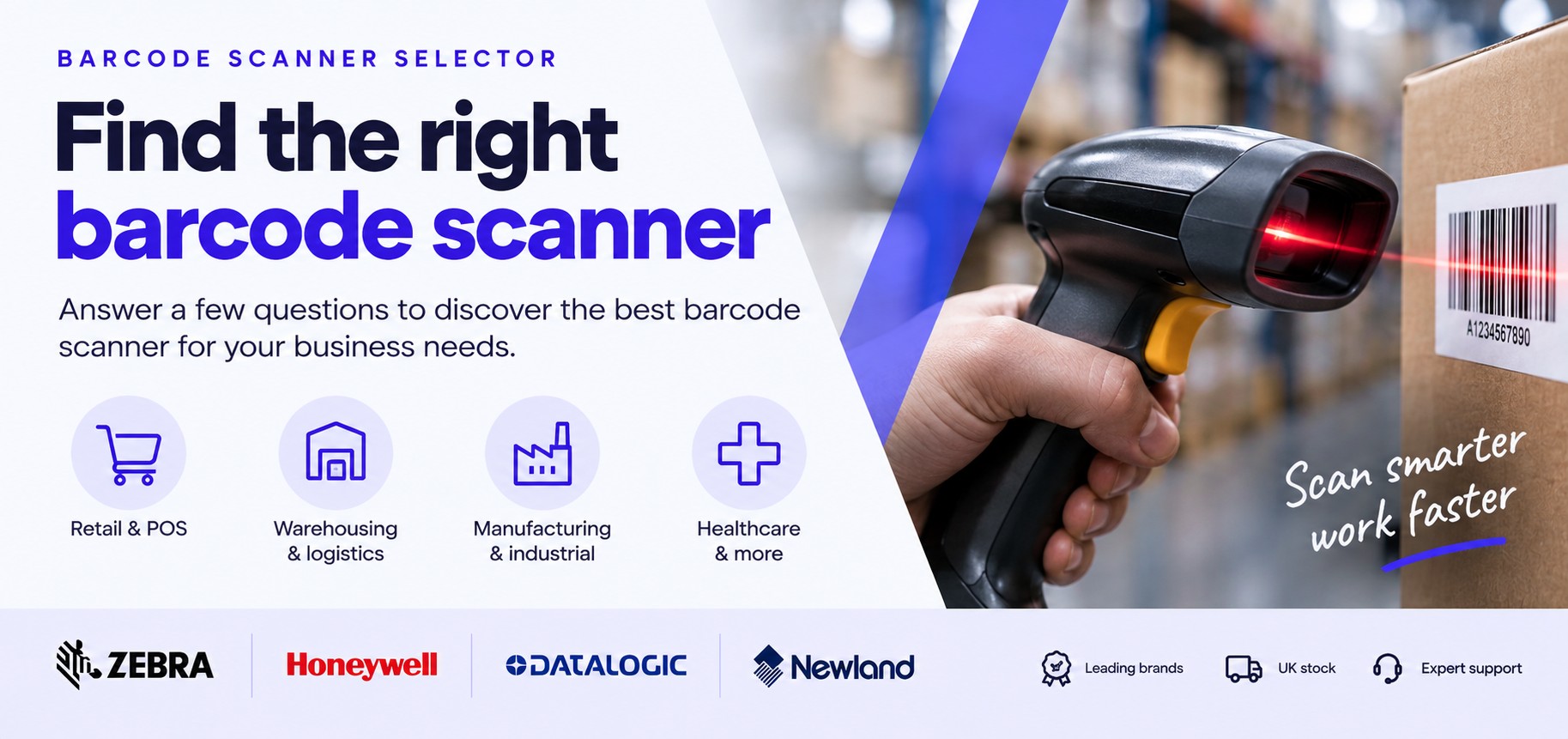
Tek Direkt supplies barcode scanners from Zebra, Honeywell, Datalogic and Newland, covering everyday scanning through to demanding industrial applications.
Barcode scanners for different applications
Retail and EPOS
Handheld and presentation scanners for retail checkouts, product identification and customer-facing environments. Consider 2D scanning for QR codes and modern retail applications.
Popular families: Zebra DS2208, Honeywell Voyager 1470g and Datalogic QuickScan.
Warehousing and logistics
Rugged scanners for stock control, picking, dispatch and warehouse operations. Extended-range variants can help with barcodes on warehouse racking.
Popular families: Zebra DS3600, Honeywell Granit and Datalogic PowerScan.
Manufacturing
Scanners for production tracking, work-in-progress identification and component traceability. Industrial environments may require greater durability or specialist barcode reading capabilities.
Popular families: Zebra DS3600 and Datalogic PowerScan.
Healthcare
Barcode scanning supports patient identification, sample tracking and inventory management. Check whether a healthcare-specific scanner configuration is required for your application.
Popular families: Zebra DS8100 and Honeywell Xenon XP.
Office and general use
Wired USB scanners offer a straightforward solution for asset tracking, document identification and everyday barcode capture. Cordless models provide additional flexibility.
Popular families: Zebra DS2200 and Honeywell Voyager.
Direct Part Marking (DPM)
Specialist scanners read codes marked directly onto metal, plastic and manufactured components. DPM scanning requires a suitable scanner configuration and should be tested against the actual marks.
Popular families: Zebra DS3600-DP and Datalogic PowerScan DPX.
Understanding barcode scanner types
Not every barcode scanner is designed for the same job. The barcode format, scanning distance, working environment and connection method all influence which model is most suitable.
1D barcode scanners
Designed to read traditional linear barcodes such as EAN, UPC and Code 128. Suitable for applications where only standard 1D codes are used.
For businesses planning to introduce QR codes or Data Matrix codes, a 2D scanner may offer greater flexibility.
2D barcode scanners
Imaging scanners that can read both traditional 1D barcodes and supported 2D formats, including QR codes and Data Matrix.
Commonly used in retail, healthcare, stock control and applications involving barcodes displayed on mobile phone screens.
Wired barcode scanners
Typically connected through USB, wired scanners suit fixed workstations, retail counters and packing benches.
They avoid battery charging requirements and are often a straightforward option for stationary scanning.
Cordless barcode scanners
Bluetooth and other wireless scanners provide greater freedom of movement for stocktaking, larger items and scanning away from a fixed workstation.
Check wireless range, battery life, charging options and host compatibility before choosing.
Long-range barcode scanners
Extended-range scan engines can read suitable barcodes at greater distances, making them useful for warehouse racking and industrial applications.
Actual reading distance depends on barcode size, quality, symbology and the specific scan engine.
Direct Part Marking scanners
DPM scanners are designed for challenging codes permanently marked onto manufactured components, including laser-etched and dot-peen markings.
Not all industrial scanners can read DPM codes reliably. Testing against representative samples is recommended.
More help choosing scanning equipment
Explore our guides and product categories for more detailed advice.
- Browse barcode scanners – handheld, cordless, presentation and industrial scanning equipment.
- Barcode Scanner Buyer's Guide – guidance on selecting the right scanner for your application.
- Direct Part Marking scanning – specialist advice for reading codes marked directly onto components.
- Ask Tek Direkt for advice – tell us about your application and we'll help identify suitable equipment.
Important: Scanner model families often include different configurations and scan engines. Always check the exact manufacturer's part number, supported symbologies, connection type and scanning distance before ordering.