We use cookies to make your experience better.
To comply with the new e-Privacy directive, you agree to the privacy policy and our use of cookies.

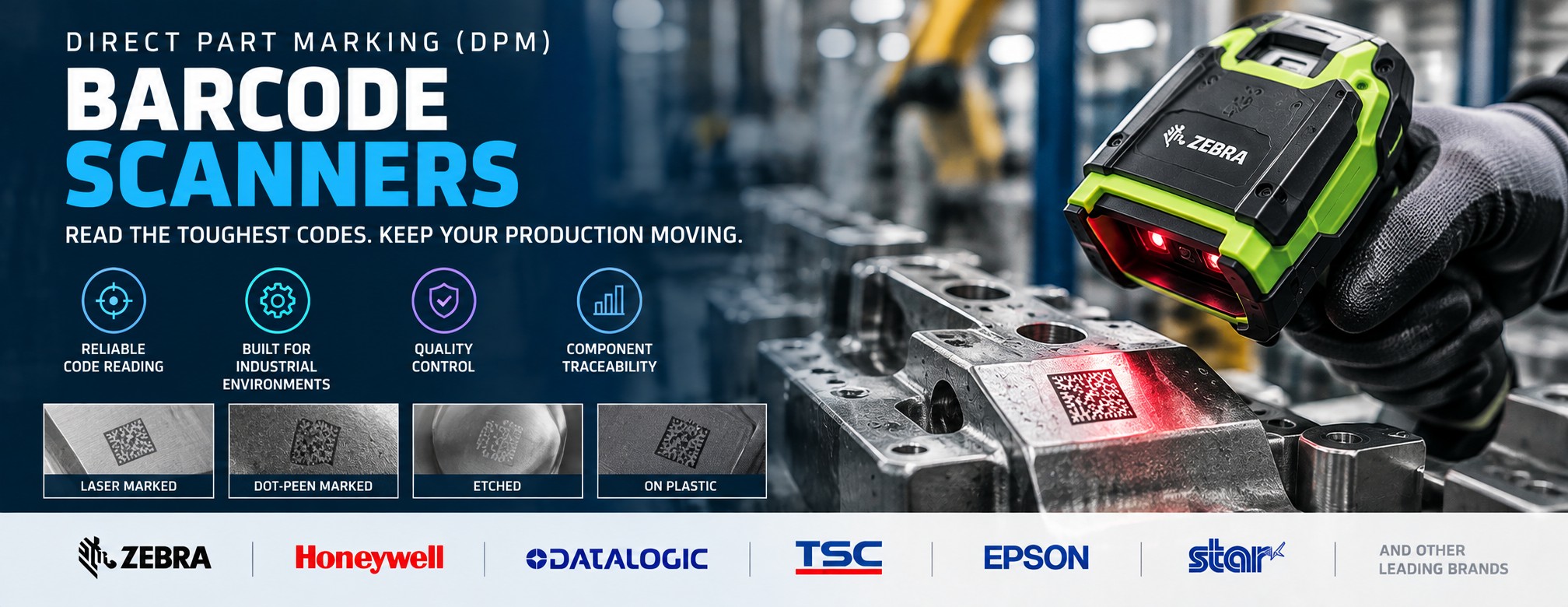
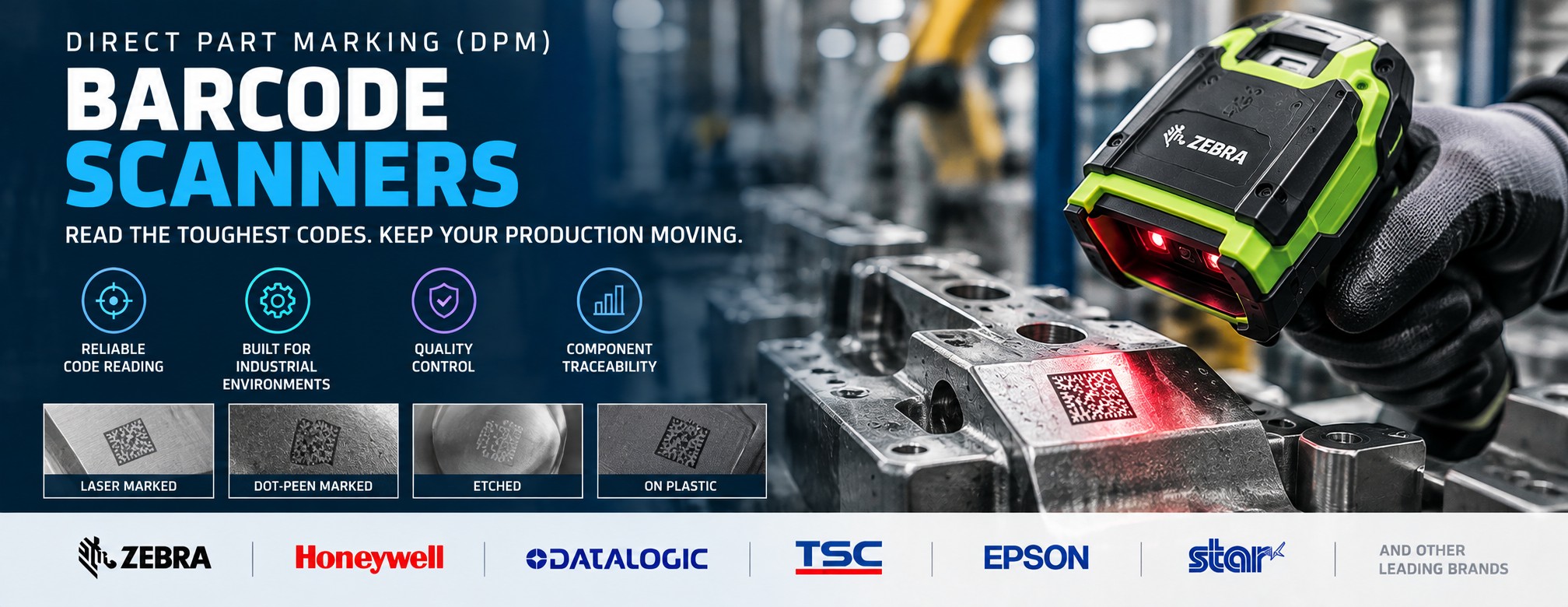
Direct Part Marking (DPM) Barcode Scanners
Tek Direkt supplies Direct Part Marking (DPM) barcode scanners for manufacturers and industrial businesses that need to read permanent machine-readable codes marked directly onto components, products and parts.
DPM scanners are designed to capture challenging codes created using processes such as laser marking, dot peen, chemical etching and engraving, where conventional barcode scanners may struggle with low contrast, reflective surfaces or irregular markings.
Choose from specialist DPM scanning solutions from Zebra, Honeywell and Datalogic for manufacturing, automotive, aerospace, electronics, engineering and other traceability applications.
If you already know the scanner or configuration you require, send Tek Direkt the manufacturer part number (MPN) and quantity for a business quote.
What Is Direct Part Marking?
Direct Part Marking is a method of permanently marking a machine-readable code directly onto a manufactured component rather than applying a separate adhesive barcode label.
The mark remains associated with the component itself, making DPM particularly useful where businesses need identification and traceability throughout production or potentially throughout the working life of a part.
DPM codes are commonly created using methods including:
- Laser marking
- Dot-peen marking
- Chemical etching
- Engraving
- Other permanent marking processes
Data Matrix is particularly common for DPM because a relatively large amount of identification data can be encoded within a compact 2D symbol.
Why Do DPM Codes Need a Specialist Scanner?
A standard barcode printed in black on a white label provides strong contrast and a relatively consistent surface.
Directly marked codes can be much more difficult to read.
A DPM scanner may need to capture a code that is:
- Etched into metal
- Laser marked onto plastic
- Dot-peened into a component
- Low contrast
- Very small
- Printed on a curved surface
- Located on reflective material
- Surrounded by machining marks or surface texture
- Viewed under difficult lighting conditions
Specialist DPM scanners use imaging and illumination technologies designed to improve capture of these challenging marks.
For this reason, businesses should not assume that every standard 2D barcode scanner will reliably read a DPM code simply because it supports Data Matrix.
DPM Scanners for Manufacturing
Direct Part Marking is particularly relevant to manufacturing environments where individual components need to be identified as they move through production.
DPM barcode scanning can support applications including:
- Component identification
- Production tracking
- Work-in-progress
- Assembly verification
- Quality control
- Inspection
- Batch and lot traceability
- Maintenance records
- Warranty identification
- Finished-product traceability
Where permanent component identification is required, DPM can provide an alternative to labels that could become detached, damaged or unreadable during the product lifecycle.
Where conventional printed barcode labels are more appropriate, explore our Label Printers for Manufacturing page for industrial, desktop and mobile printing options for product identification, work-in-progress, batch, serial number and traceability labels.
For broader manufacturing scanning requirements, see our Barcode Scanners for Manufacturing page.
DPM Scanners for Automotive & Engineering
Automotive and engineering applications can require traceability across individual components, assemblies and production stages.
Permanent Data Matrix and other DPM codes can be applied to components so they can be identified during manufacturing, inspection and subsequent processes.
Typical applications can include:
- Engine and transmission components
- Machined parts
- Bearings
- Cast components
- Automotive assemblies
- Tools
- Engineering components
- Metal parts
The correct scanner will depend heavily on the marking method, material, code size, contrast and surface condition.
DPM Scanners for Electronics
Electronics manufacturing can involve very small components and compact identification codes.
DPM and high-performance 2D scanning can be used for identification and traceability of components, assemblies and electronic products where conventional barcode labels may not be practical.
Small code size makes image quality and scanner capability particularly important.
When dealing with very small Data Matrix codes, check the scanner's specification against the actual code dimensions rather than relying only on a general claim of DPM compatibility.
DPM Scanners for Aerospace & Traceability
Aerospace and other highly controlled manufacturing environments can require individual parts and components to remain identifiable throughout complex production, inspection and maintenance processes.
Permanent part marking can support this traceability where conventional labels would not provide an appropriate long-term identification method.
Scanner selection should take account of the marking standard, code dimensions, component material and the conditions under which the code will be read.
Laser-Marked DPM Codes
Laser marking can create precise permanent codes on metals, plastics and other materials.
However, readability can vary depending on the material and the contrast created by the marking process.
Reflective surfaces can be particularly challenging because illumination from the scanner can produce glare.
A DPM-capable scanner uses specialised illumination and image processing to help capture these types of marks.
Dot-Peen DPM Codes
Dot-peen marking creates a code using a series of small indentations in the component surface.
Rather than relying entirely on colour contrast, the scanner may need to interpret differences created by the physical structure of the mark and the way light interacts with it.
This can make dot-peen codes considerably more challenging for conventional barcode scanners.
If your application specifically involves dot-peen Data Matrix codes, tell us when requesting a scanner recommendation.
DPM Scanners for Metal Components
Metal is one of the most common materials associated with Direct Part Marking.
Machined, polished, cast and textured metal surfaces can all present different scanning challenges.
Successful DPM scanning depends not only on the scanner but also on:
- Surface finish
- Marking method
- Code size
- Mark quality
- Lighting
- Scanning angle
- Working distance
For difficult applications, testing representative marked components before a large hardware deployment is strongly recommended.
Zebra DPM Barcode Scanners
Zebra Technologies offers specialist DPM configurations within several of its barcode scanner families.
Options include rugged industrial scanners from the Zebra DS3600 Series alongside other DPM-capable scanners designed for manufacturing and component identification.
Zebra DPM scanners can be particularly relevant where businesses require a combination of rugged construction and specialist direct-part-mark reading capability.
Always check the complete Zebra MPN because standard and DPM versions of apparently similar scanner families can have significantly different capabilities.
Honeywell DPM Barcode Scanners
Honeywell supplies specialist scanning technology for manufacturing and industrial traceability, including scanners designed to capture challenging direct-part marks.
Honeywell DPM solutions can be considered for applications involving low-contrast and difficult codes on industrial components.
As with other manufacturers, verify the exact scanner configuration against the codes being used in your application.
Datalogic DPM Barcode Scanners
Datalogic provides industrial scanning solutions for manufacturing and traceability, including DPM-capable configurations within its rugged scanning ranges.
Datalogic PowerScan products are widely used in industrial environments, with specialist configurations available for demanding code-reading applications.
Check the complete manufacturer part number to ensure the selected PowerScan configuration provides the required DPM capability.
Handheld vs Fixed DPM Scanning
DPM applications can use different scanning approaches depending on how the production process operates.
Handheld DPM Scanners
A handheld DPM scanner allows an operator to position the scanner relative to the component.
This can be useful where:
- Components vary in size
- Codes appear in different positions
- Operators inspect parts manually
- The scanner is used across several workstations
- Production volumes don't justify automated scanning
Fixed-Mount DPM Scanning
Higher-volume or automated production environments may use fixed scanning or machine-vision equipment where components move through a controlled inspection point.
The correct approach depends on production speed, code consistency, automation requirements and the level of operator involvement.
Corded or Cordless DPM Scanner?
For a fixed inspection or production workstation, a corded DPM scanner can provide a simple connection without batteries or charging requirements.
A cordless DPM scanner can be more suitable where operators need to move around large components, assemblies or a wider working area.
Don't choose solely on corded versus cordless operation, however. The scanner's ability to reliably capture the actual DPM code should remain the primary consideration.
How to Choose a DPM Barcode Scanner
Before choosing a DPM scanner, establish exactly what needs to be read.
Important considerations include:
- Symbology – commonly Data Matrix, but confirm the actual code
- Marking method – laser, dot peen, etching or engraving
- Material – metal, plastic or another surface
- Surface finish – matt, polished, reflective or textured
- Code dimensions
- Cell/module size
- Working distance
- Scanning angle
- Lighting conditions
- Environment
- Corded or cordless operation
- Required ruggedness
- Host-system connectivity
Where possible, test the intended scanner against representative production parts.
A scanner that performs extremely well on one DPM application may not necessarily be the best option for a different material or marking process.
DPM Barcode Scanner vs Standard 2D Scanner
Both standard 2D scanners and DPM scanners can support symbologies such as Data Matrix.
The important difference is how the code is presented.
A conventional 2D scanner is generally designed around printed barcodes and labels with predictable contrast.
A DPM scanner is designed to handle the more challenging optical characteristics of codes permanently marked into or onto component surfaces.
If you only scan printed labels, you may not need the additional capabilities of a DPM scanner.
If you need to scan laser-etched, dot-peen or otherwise directly marked codes, choose a scanner specifically designed and configured for DPM.
DPM Scanning as Part of Manufacturing Traceability
DPM scanning is normally one element of a wider manufacturing identification system.
A typical process might use a permanent code to identify an individual component, with that identifier captured at different points during:
Manufacture → Assembly → Inspection → Quality Control → Finished Product → Service
The information associated with each scan depends on the software and traceability system being used.
For organisations that also need conventional barcode scanning elsewhere in production, see our Barcode Scanners for Manufacturing page.
Buy Direct Part Marking Barcode Scanners
Tek Direkt supplies DPM barcode scanners for manufacturing, engineering and industrial traceability applications from Zebra, Honeywell, Datalogic and other leading manufacturers.
If you already know the scanner you require, send us the manufacturer part number (MPN) and quantity for a business quote.
If you're comparing an existing supplier quotation, send us the exact MPN and quantity and we'll provide another price to compare.
For applications involving difficult DPM codes, tell us the marking method, material, approximate code size and working environment so the requirement can be narrowed down to suitable hardware.

