

Asset Identification • Outdoor Equipment • Harsh Environments
Will Your Barcode Label Last as Long as the Asset?
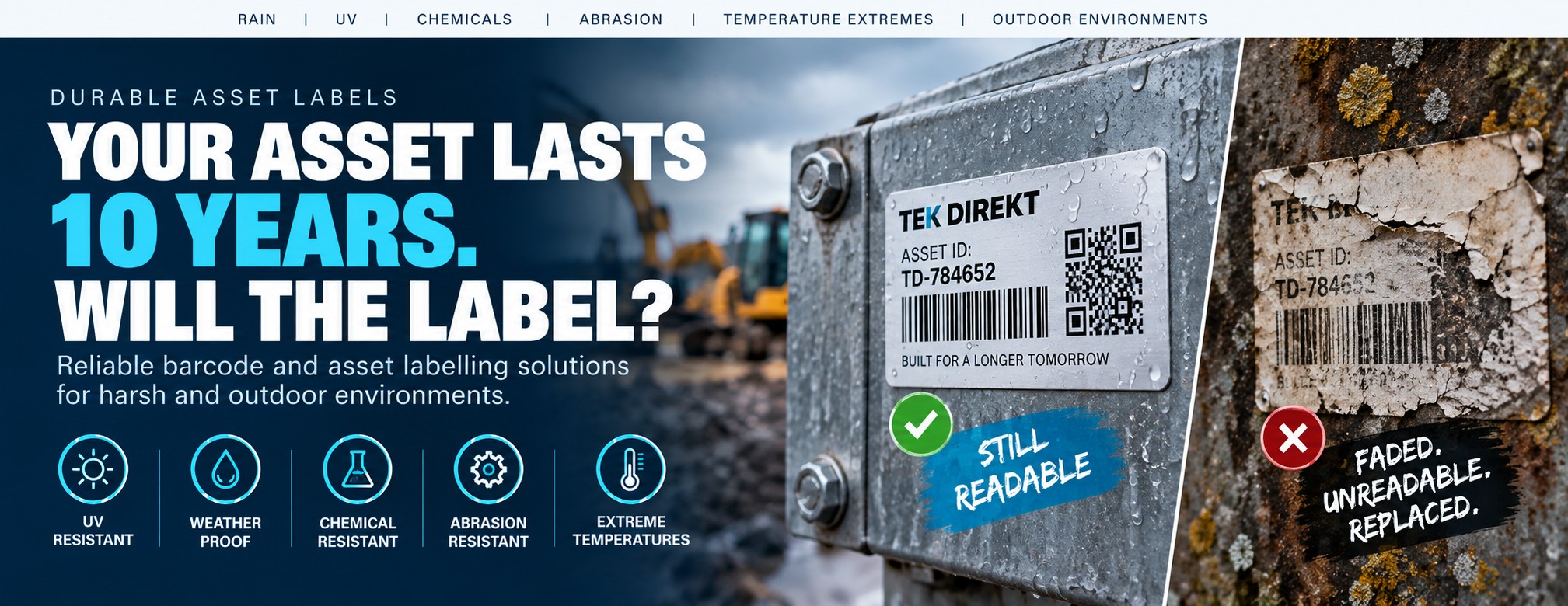
A barcode label can be perfectly readable when it's first applied — then spend the next several years dealing with sunlight, rain, dirt, oil, cleaning, abrasion and changing temperatures.
If the label becomes unreadable or falls off before the equipment reaches the end of its working life, you've lost the physical link between the asset and the information attached to it.
Long-life asset identification therefore needs more than simply choosing a barcode printer.
The Printer Isn't the Only Thing That Determines Label Life
A durable asset label is a complete system.
The printer, printing method, label material, adhesive and ribbon all need to suit the surface and environment in which the finished label will actually be used.
A Good Printer Can't Fix the Wrong Label Material
You can use a professional industrial printer and still end up with an unsuitable asset label if the media, adhesive or ribbon doesn't match the application.
What Does the Label Need to Survive?
Sunlight & UV
Outdoor labels can face prolonged exposure to sunlight, making material and print durability important.
Rain & Moisture
Labels used outdoors or in wet environments need to remain attached and readable when exposed to moisture.
Oil & Grease
Machinery, vehicles and industrial equipment may expose identification labels to oils and other contaminants.
Cleaning Chemicals
Repeated cleaning can affect both the printed image and the label material if they aren't suited to the process.
Abrasion
Labels on tools, machinery and frequently handled equipment can be rubbed, scraped or knocked during normal use.
Temperature Changes
Assets used outdoors, in vehicles or around industrial processes can experience significant changes in temperature.
For Long-Life Labels, Printing Method Matters
Direct thermal and thermal-transfer printing may look similar from the outside, but they create the printed image differently.
Direct Thermal
Direct-thermal printers create the image by applying heat to heat-sensitive label media.
This can be extremely useful for many shorter-life applications where a ribbon isn't required.
Common uses include:- Shipping labels
- Short-life logistics labels
- Receipts and tickets
- Applications where long-term durability isn't required
Thermal Transfer
Thermal-transfer printing uses a ribbon to transfer the printed image onto the label material.
With the correct combination of media and ribbon, it is generally the more appropriate starting point for durable identification applications.
Common uses include:- Asset identification
- Industrial labels
- Equipment labels
- Longer-life barcode identification
Think Beyond the Printer
For demanding asset labels, we'd normally start by understanding the required lifespan and environment, then work backwards to the appropriate media, adhesive, ribbon and printer.
Paper Isn't the Only Label Material
Standard paper labels are ideal for many everyday applications, but harsh or long-life environments can require more durable synthetic media.
Paper
Cost-effective for many general barcode applications where exposure and required lifespan are limited.
Synthetic Media
Synthetic label materials can offer greater resistance to moisture, tearing and demanding environmental conditions.
Specialist Materials
More demanding applications may require media selected specifically for the surface, environment and expected working life.
The Label Has to Stay Attached Too
Print durability isn't much use if the label itself lifts, curls or falls off the asset.
Adhesive selection can depend on the surface material, texture, temperature at application, operating environment and expected service life.
Smooth Surfaces
Metal cabinets, equipment housings and other smooth surfaces can have different adhesive requirements from rough or textured materials.
Textured Surfaces
Rough, moulded or uneven surfaces may require an adhesive designed to maintain contact with a more difficult substrate.
Curved Surfaces
Pipes, cylinders, tools and other curved assets can place additional stress on the label and adhesive.
Then There's the Ribbon
In thermal-transfer printing, the ribbon is part of the durability equation too.
Different ribbon formulations provide different performance characteristics, so the ribbon should be matched to the label material and intended application.
Printer + Media + Adhesive + Ribbon
For a demanding asset-identification application, these shouldn't be treated as four unrelated purchasing decisions.
They need to work together to produce a label appropriate for the surface, environment and required lifespan.
Who Needs Durable Asset Labels?
Utilities & Energy
Identify equipment, cabinets, meters and infrastructure used across operational sites.
Telecommunications
Label cabinets, network hardware, field equipment and other infrastructure assets.
Solar & Renewables
Identify installed equipment including inverters, electrical components and associated assets.
Facilities Management
Track HVAC, plant, electrical equipment and building assets across customer sites.
Plant & Tool Hire
Keep machinery, tools and hire equipment identifiable throughout repeated use and movement.
Engineering & Manufacturing
Identify machinery, production equipment, tooling and other long-life industrial assets.
HVAC & Building Services
Label installed plant and equipment that may remain in service for many years.
Fire & Security
Identify alarms, extinguishers, CCTV, access-control equipment and serviceable assets.
Water & Wastewater
Label pumps, valves, cabinets and equipment in demanding operational environments.
How Long Does the Label Actually Need to Last?
Before choosing a printer, label or ribbon, define the expected working life of the identification.
A label required for a few months has a very different job from an asset label expected to remain readable for several years.
Short-Term
Temporary identification, logistics and other applications where the label only needs to remain readable for a relatively limited period.
Long-Term Indoor
Asset labels used on machinery, IT equipment, plant, cabinets and other equipment kept predominantly indoors.
Long-Term Outdoor
Identification exposed to weather, sunlight, moisture, temperature changes and other demanding conditions.
Tell Us Where the Label Has to Survive
You don't need to know which label material or ribbon you need. Start by describing the application.
1. Indoor or Outdoor?
Will the asset remain inside a controlled environment, operate outdoors or regularly move between the two?
2. What Is the Surface?
Is the label being applied to painted metal, stainless steel, plastic, glass, a textured surface or something else?
3. How Long Must It Last?
Are you looking for identification that lasts months, several years or potentially the working life of the asset?
4. What Will It Be Exposed To?
Tell us about sunlight, water, oils, cleaning products, chemicals, abrasion, dirt and temperature changes.
5. What Size Is the Label?
Give us the approximate width and height available on the asset for the identification label.
6. How Many Do You Need?
Tell us whether you're producing occasional replacement labels or identifying hundreds or thousands of assets.
What Will Come Into Contact With the Label?
“Chemical resistant” can mean very different things depending on the actual application.
If the label is going to be cleaned, exposed to oils or used around industrial chemicals, tell us exactly what it is likely to encounter.
Don't Just Say “Harsh Environment”
The more specific the application information, the easier it is to narrow down appropriate media and ribbon combinations.
If you know the cleaning product, solvent, oil or chemical involved, include that information when you contact us.
What Needs to Be Printed?
Durable identification isn't limited to a simple barcode. The label may need to carry several types of information.
Barcode
Encode an asset number or other identifier for fast scanning with compatible barcode equipment.
QR or Data Matrix
Use compact 2D codes where the application and associated systems require them.
Human-Readable ID
Print asset numbers, serial numbers and other information that remains readable without a scanner.
Service Information
Include suitable inspection, maintenance or equipment information where required by the workflow.
Company Information
Add business or ownership information where this forms part of the asset-identification requirement.
Serialisation
Give every asset a unique identifier linked to your asset-management, maintenance or inventory system.
Desktop or Industrial Label Printer?
Once the label construction is understood, the next question is how many labels need to be produced and where printing will take place.
Desktop Thermal-Transfer Printer
A desktop printer can be a good fit where durable asset labels are produced in smaller quantities and the required media fits within the printer's capabilities.
- Lower-volume asset labelling
- Office or workshop use
- Smaller batches
- Compact printing area
Industrial Thermal-Transfer Printer
Industrial printers are better suited to demanding production environments and higher print volumes.
- Higher-volume label production
- Manufacturing environments
- Regular daily printing
- Industrial workflows
Would RFID Add Anything to the Asset?
Some asset-management applications can also use RFID identification. That doesn't mean every durable asset label should automatically become an RFID label.
RFID may be worth considering where the wider tracking process benefits from identifying suitable tagged assets without relying entirely on direct line-of-sight barcode scanning.
Barcode and RFID Can Work Together
An RFID asset label can still carry a printed barcode and human-readable asset information, giving the organisation more than one method of identifying the asset.
Before You Choose an Asset Label
These are the questions we'd want answered before recommending a durable label setup:
- How many years does the identification need to remain readable?
- Will the label be used indoors, outdoors or both?
- What material and surface will it be attached to?
- Is the surface smooth, rough, textured or curved?
- Will the label be exposed to sunlight?
- Will it regularly get wet?
- Will it come into contact with oils or grease?
- Will it be cleaned with chemicals or solvents?
- Will the surface be rubbed, scraped or frequently handled?
- What temperatures will the asset experience?
- What dimensions can the label be?
- Does it need a barcode, QR code, Data Matrix or RFID?
- How many labels need to be printed?
For Demanding Applications, Test the Complete Label
When an asset label needs to survive for years in a difficult environment, selecting products from specification sheets alone may not be enough.
Testing should reflect the real application as closely as possible.
Actual Surface
Apply the label to the same material and finish used on the real asset.
Actual Exposure
Where practical, evaluate the label against the moisture, cleaning, abrasion or contaminants it will encounter.
Actual Barcode
Confirm that the printed barcode remains readable using the scanners involved in the real workflow.
Tell Us Where the Label Has to Survive
Don't start by trying to choose between hundreds of label materials and ribbons.
Tell us what you're labelling, what the surface is, whether it's indoors or outdoors, what it will be exposed to and how long it needs to last.
From there, we can help narrow down the type of printer, media and ribbon combination worth considering.
Discuss Your Asset LabelExamples of Assets That May Need Durable Identification
Plant & Machinery
Production equipment, pumps, motors and industrial machinery.
Electrical Equipment
Panels, cabinets, controls and installed electrical assets.
HVAC Equipment
Air-conditioning, heating, ventilation and building plant.
Tools & Hire Equipment
Portable equipment that moves between people, sites and jobs.
Field Infrastructure
Cabinets, meters, communications and utility equipment.
Vehicles & Mobile Assets
Equipment exposed to vibration, dirt and changing environments.
Already Know What You Need?
If you already know the printer, media, ribbon or manufacturer part number required, send us the MPN and quantity and we'll provide another business price to compare.
Your Asset Could Be There for Years. The Label Needs to Keep Up.
Rain. Sunlight. Oil. Cleaning. Chemicals. Abrasion. Temperature changes.
The right durable-label solution starts with understanding what the finished label will actually have to survive.
Help Me Choose a Durable Label SetupImportant: label durability depends on the complete application, including label material, adhesive, ribbon, surface preparation, substrate, environmental exposure, printing method and expected working life.
Terms such as waterproof, outdoor, chemical-resistant and permanent can cover very different performance requirements. Suitability should therefore be checked against the actual conditions in which the label will be used.
For demanding or long-life applications, testing the proposed media, ribbon and adhesive on representative assets under realistic conditions is recommended before a larger deployment.