We use cookies to make your experience better.
To comply with the new e-Privacy directive, you agree to the privacy policy and our use of cookies.

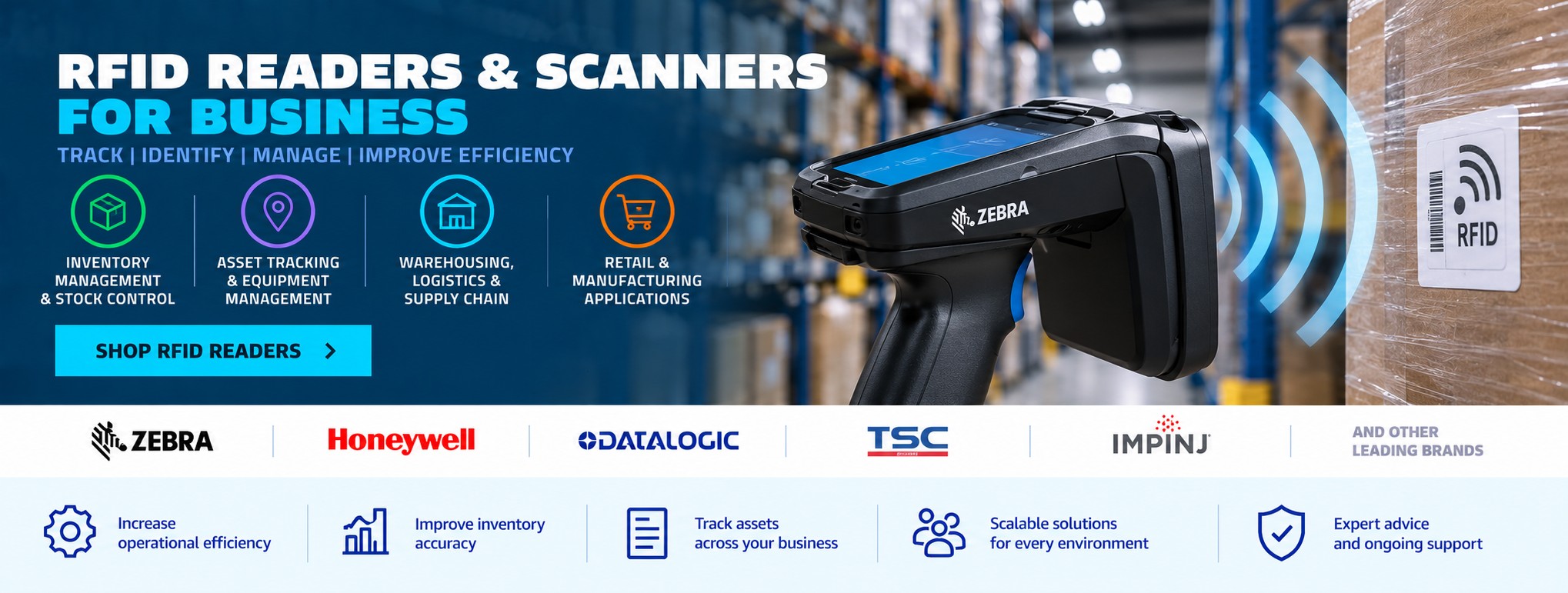
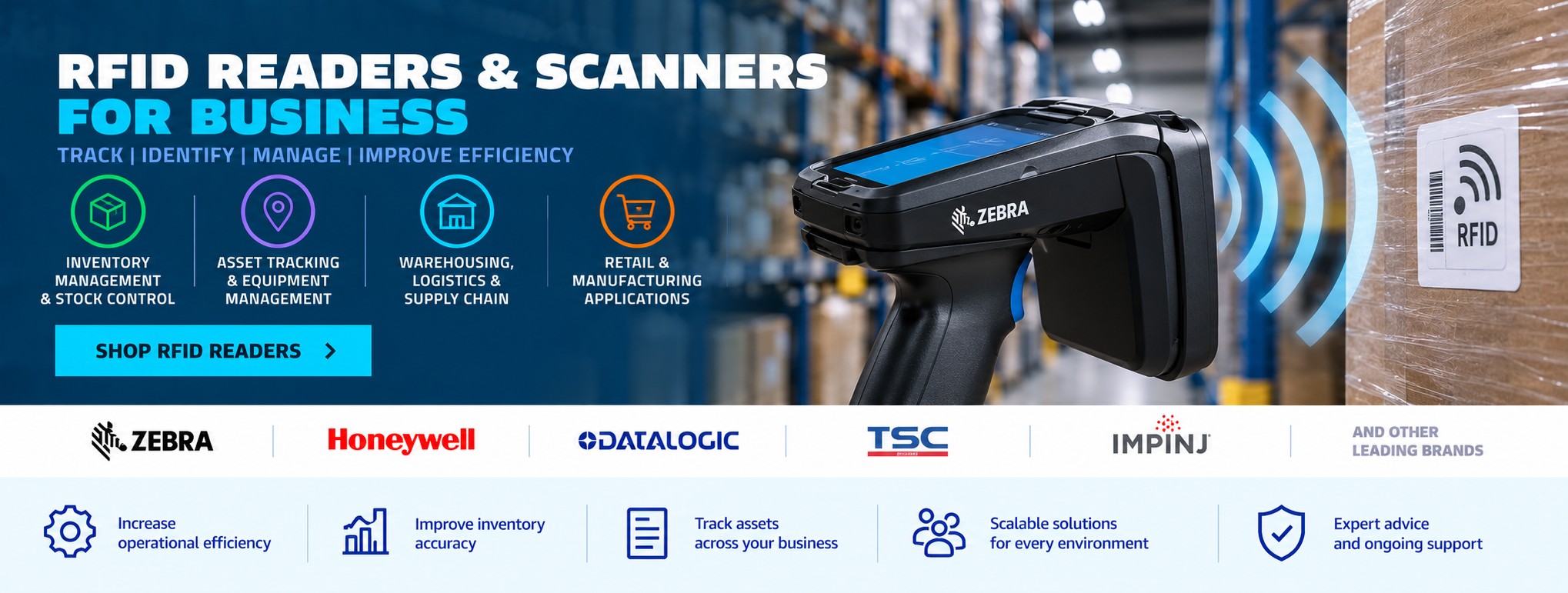
RFID Readers & Scanners for Business
RFID technology allows businesses to identify and track tagged products, assets and inventory without requiring every item to be individually aligned with a barcode scanner.
Tek Direkt supplies RFID readers and scanners for businesses across the UK, including handheld RFID readers, mobile RFID devices and fixed RFID reading technology for inventory, asset tracking, warehousing, manufacturing, retail and other operational applications.
Whether you're replacing existing RFID hardware, expanding a deployment or sourcing equipment for a new project, choosing the right reader depends on the RFID technology, tags, reading environment, software and workflow involved.
RFID Readers & RFID Scanners
RFID readers communicate with compatible RFID tags using radio-frequency technology.
Unlike conventional barcode scanning, RFID does not necessarily require a visible printed barcode to be positioned directly in front of the reader.
Depending on the system and environment, RFID technology can be used to identify tagged items as they:
-
Enter or leave an area
-
Move through a warehouse
-
Pass through a doorway or portal
-
Are counted during inventory
-
Move through manufacturing processes
-
Are issued or returned
-
Arrive at a retail location
-
Move between business sites
The correct RFID hardware depends heavily on the application.
UHF RFID Readers
UHF RFID is widely used for business applications involving inventory, assets, logistics and supply-chain visibility.
A UHF RFID system can combine:
RFID tags → RFID reader → Antenna → Business software
The reader captures information from compatible RFID tags and passes that data to the application responsible for processing it.
Potential applications include:
-
Inventory management
-
Asset tracking
-
Warehouse operations
-
Goods receiving
-
Stocktaking
-
Manufacturing
-
Logistics
-
Retail inventory
-
Equipment management
-
Supply-chain tracking
RFID performance depends on much more than simply selecting a reader, so the tags, antennas, environment and software should all be considered as part of the project.
Handheld RFID Readers
Handheld RFID readers allow employees to take RFID data capture directly to the products or assets being identified.
They can be particularly useful where employees need to move through:
-
Warehouse aisles
-
Stockrooms
-
Retail stores
-
Manufacturing facilities
-
Equipment stores
-
Offices
-
Healthcare facilities
-
Storage locations
A handheld RFID device can support applications such as stock counts, asset searches, inventory checks and item identification without requiring the tagged objects to pass a fixed reader location.
Mobile Computers with RFID
Some enterprise mobile computers incorporate RFID reading capability or can be combined with compatible RFID accessories.
This can allow one mobile device to support several parts of a workflow, potentially including:
-
RFID tag reading
-
Barcode scanning
-
Application access
-
Inventory updates
-
Product lookup
-
Asset searches
-
Wireless data communication
For businesses already using enterprise mobile computers, an RFID-capable mobile platform may provide a more integrated approach than deploying completely separate handheld devices.
The exact capability depends on the device and configuration, so always check the full manufacturer part number before ordering.
Fixed RFID Readers
Fixed RFID readers are designed for installations where RFID tags need to be captured at defined locations rather than by an employee carrying a handheld reader.
Potential locations include:
-
Warehouse doorways
-
Goods-in areas
-
Goods-out areas
-
Dock doors
-
Production lines
-
Manufacturing workstations
-
Stockroom entrances
-
Retail backrooms
-
Asset-control points
A fixed RFID installation may use one reader with one or more antennas positioned around the reading area.
Reader placement, antenna selection and the surrounding environment can have a significant effect on performance.
Handheld vs Fixed RFID Readers
The right format depends on how items move through the operation.
Choose a handheld RFID reader where employees need to move around and actively locate, identify or count tagged items.
Choose a fixed RFID reader where tagged items move through a known location and the objective is to capture them automatically.
Some businesses use both.
For example:
Goods receiving: fixed RFID infrastructure.
Warehouse stocktaking: handheld RFID reader.
Asset search: handheld RFID reader.
Production checkpoint: fixed RFID reader.
The hardware should follow the workflow rather than the other way around.
RFID for Inventory Management
Inventory is one of the most important commercial applications for RFID technology.
Traditional barcode-based inventory normally requires each barcode to be presented to a scanner.
RFID can provide a different approach because compatible tags may be read using radio-frequency technology without requiring the same direct visual alignment.
Potential inventory applications include:
-
Stock counts
-
Inventory verification
-
Stock location
-
Goods receiving
-
Goods dispatch
-
Stock transfers
-
Cycle counting
-
Item searches
-
Replenishment
The potential benefit depends on the type of inventory, tagging strategy and software environment.
RFID should therefore be evaluated around the actual process rather than treated as an automatic replacement for barcode technology.
RFID for Asset Tracking
Businesses can use RFID technology to help identify and track tagged assets.
For businesses looking at the wider hardware required to identify, audit and manage equipment, tools and other physical assets, see our Asset Tracking Technology & Hardware page.
Applications can include:
-
IT equipment
-
Tools
-
Machinery
-
Reusable containers
-
Medical equipment
-
Test equipment
-
Business assets
-
High-value items
-
Equipment issued to employees
A handheld RFID reader can be particularly useful where employees need to locate tagged assets across a building or storage environment.
Fixed readers can support workflows where assets pass through controlled points.
RFID Readers for Warehousing & Logistics
Warehouses and logistics operations can use RFID alongside conventional barcode technology.
Potential RFID workflows include:
-
Goods receiving
-
Inventory counts
-
Pallet identification
-
Stock movement
-
Asset tracking
-
Goods dispatch
-
Container tracking
-
Returnable asset management
RFID can be particularly useful where the objective is to identify multiple tagged items or capture movement through defined areas.
Barcode scanning remains appropriate for many warehouse processes, so the two technologies frequently operate alongside one another rather than one completely replacing the other.
For conventional warehouse scanning applications, see our Warehouse Barcode Scanners page.
For mobile warehouse data capture, see our Mobile Computers for Warehousing & Logistics page.
RFID Readers for Manufacturing
Manufacturing businesses may use RFID to identify materials, components, tools, assets or products as they move through operational processes.
Potential applications include:
-
Work-in-progress tracking
-
Component identification
-
Tool tracking
-
Asset management
-
Production visibility
-
Inventory management
-
Reusable-container tracking
-
Goods movement
The industrial environment should be considered carefully when selecting RFID hardware.
Metal, liquids, machinery, reader positioning and the physical location of RFID tags can all affect how an RFID system needs to be designed.
For conventional barcode data capture in production environments, see our Barcode Scanners for Manufacturing page.
RFID Readers for Retail
RFID can support retail inventory and stock-management applications beyond the checkout.
Potential uses include:
-
Stocktaking
-
Inventory visibility
-
Goods receiving
-
Stockroom management
-
Product location
-
Replenishment
-
Stock transfers
-
Asset tracking
Handheld RFID devices can allow employees to move through a store or stockroom while identifying compatible tagged products.
Retailers may therefore use several data-capture technologies across the same operation.
A typical environment could combine:
Barcode scanners at checkout → Mobile computers for stock control → RFID readers for tagged inventory
For handheld inventory and stock-control workflows, see our Mobile Computers for Retail & Stock Control page.
RFID or Barcode Scanning?
RFID and barcode scanning are different technologies, and neither is automatically the correct choice for every application.
Barcode Scanning
A barcode scanner normally requires the barcode to be visible to the scanning device.
Barcode technology is widely used because it is established, cost-effective and suitable for enormous numbers of identification applications.
RFID
RFID uses radio-frequency communication between a reader and compatible tag.
It can be useful where businesses want to identify tagged items without individually positioning each printed barcode in front of a scanner.
The right choice depends on:
-
Number of items
-
Required read process
-
Existing identification technology
-
Tag cost
-
Environment
-
Software
-
Required automation
-
Accuracy requirements
-
Implementation budget
Many businesses use RFID and barcodes together.
RFID Tags & Readers
An RFID reader is only one component of an RFID system.
A deployment may involve:
-
RFID reader
-
RFID tags
-
RFID antennas
-
Mobile devices
-
Barcode scanners
-
RFID printers
-
Business software
-
Network infrastructure
The tags must be suitable for both the reader technology and the item being tagged.
For example, tagging a cardboard carton can present different requirements from tagging an asset containing metal.
The complete application should therefore be considered before purchasing reader hardware.
RFID Antennas
Fixed RFID readers may support external antennas that define where and how RFID tags are read.
Depending on the installation, antennas may be positioned around:
-
Doorways
-
Portals
-
Conveyor areas
-
Workstations
-
Shelving
-
Dock doors
-
Production areas
The number and type of antennas required depends on the reader, physical environment and required read zone.
Don't assume that purchasing a fixed RFID reader alone provides a complete RFID installation.
RFID Printing & Encoding
RFID printers can print human-readable information and barcodes while also encoding compatible RFID labels or tags.
This allows businesses to create RFID-enabled identification media as part of a wider tracking system.
RFID printing can be relevant to:
-
Warehousing
-
Manufacturing
-
Logistics
-
Retail
-
Asset identification
-
Supply-chain applications
If your project involves creating RFID labels as well as reading them, check that the printer supports the RFID technology and media required.
Zebra RFID Readers
Zebra Technologies provides RFID technology alongside its barcode scanners, mobile computers and printing hardware.
Zebra's RFID portfolio includes technology for handheld and fixed data-capture applications.
Depending on the product and configuration, Zebra RFID hardware can support applications such as:
-
Inventory
-
Asset tracking
-
Warehousing
-
Retail
-
Manufacturing
-
Logistics
Always check the complete Zebra manufacturer part number when comparing RFID hardware because different configurations, accessories and regional versions may exist within the same product family.
Honeywell RFID Technology
Honeywell provides data-capture and mobile technology for warehousing, logistics, retail and industrial environments.
Where RFID functionality is required, confirm the exact capabilities of the individual device or configuration rather than assuming RFID support from the product-family name.
Datalogic Data Capture
Datalogic supplies enterprise data-capture technology used across retail, manufacturing, warehousing and logistics.
RFID may form part of a wider Auto-ID environment that also includes barcode scanners, mobile computers and fixed industrial data capture.
When designing a mixed technology environment, consider how information from each device will reach the software platform being used.
RFID Reader Connectivity
RFID readers may need to communicate with local systems, enterprise applications or network infrastructure.
Depending on the device, connectivity can include technologies such as:
-
Ethernet
-
Wi-Fi
-
Bluetooth
-
USB
-
Mobile connectivity
-
Other manufacturer-specific interfaces
Connectivity requirements should be established before choosing the hardware.
A fixed reader installed at a warehouse doorway has very different infrastructure requirements from a handheld reader carried by an employee.
RFID Read Range
There isn't one universal RFID read distance.
Actual performance depends on factors including:
-
RFID frequency and technology
-
Reader
-
Antenna
-
Tag
-
Tag placement
-
Reader power and configuration
-
Physical environment
-
Nearby materials
-
Interference
-
Orientation
For that reason, advertised maximum figures should not be treated as a guarantee of performance in every installation.
The application should be tested under realistic operating conditions where read performance is critical.
RFID Around Metal & Liquids
The physical environment can affect RFID performance.
Metal objects and liquids can create particular challenges for some RFID deployments.
That doesn't mean RFID cannot be used in these environments, but the choice and placement of tags, antennas and readers becomes more important.
Where products, containers or assets contain significant amounts of metal or liquid, make this part of the hardware and tag evaluation from the beginning.
RFID Readers for Multi-Site Deployments
Businesses deploying RFID technology across several locations should consider standardisation as well as individual device cost.
Using consistent hardware can make it easier to:
-
Manage software
-
Maintain spare devices
-
Standardise accessories
-
Support employees
-
Replace failed equipment
-
Expand deployments
-
Manage device configurations
For larger projects, recording the exact manufacturer part numbers used within the deployment can also make future purchasing much easier.
How to Choose an RFID Reader
Before purchasing RFID reader hardware, establish:
-
Which RFID technology is being used?
-
What tags need to be read?
-
Is the application handheld or fixed?
-
What items are being identified?
-
How many tagged items need to be captured?
-
What read range is required?
-
Where will the reader be installed or used?
-
Are metal or liquids present?
-
What software will process the RFID data?
-
What network connectivity is available?
-
Are antennas required?
-
Does the project also require RFID printing?
-
Are barcode scanning and RFID both required?
-
Is the deployment for one location or multiple sites?
These requirements should be established before selecting a reader solely on price.
Build a Complete RFID & Auto-ID Solution
RFID frequently operates as part of a wider identification and data-capture environment.
A business might combine:
RFID readers + RFID tags + RFID printers + barcode scanners + mobile computers + business software
The exact combination depends on the workflow and the level of automation required.
Tek Direkt supplies RFID, barcode scanning, mobile computing and printing hardware from leading enterprise technology manufacturers.
Buy RFID Readers & Scanners
Tek Direkt supplies RFID readers, scanners and related Auto-ID hardware for UK businesses.
Whether you're sourcing a handheld RFID reader, fixed RFID hardware or equipment for a wider inventory, asset-tracking or operational project, we can help identify suitable technology.
If you already know the equipment required, send us the manufacturer part number (MPN) and quantity and we'll quote the exact configuration.
Already have another supplier's price?
Use Beat My Quote and send us the MPN, quantity or existing supplier quotation for another price to compare.

