
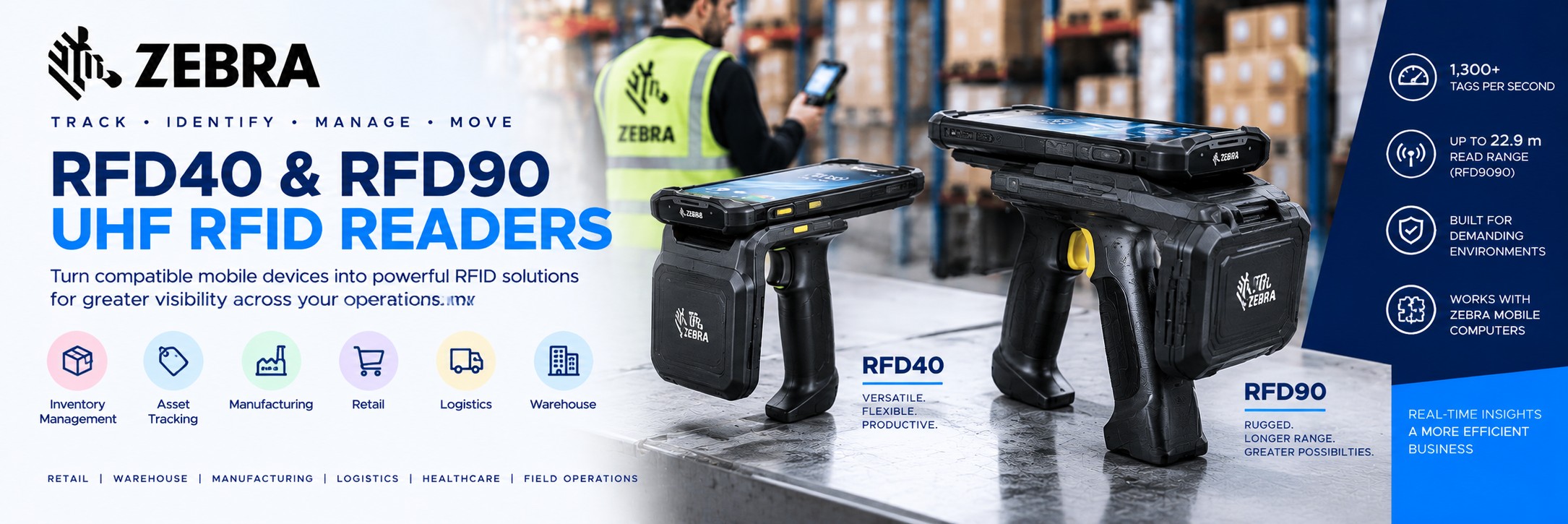
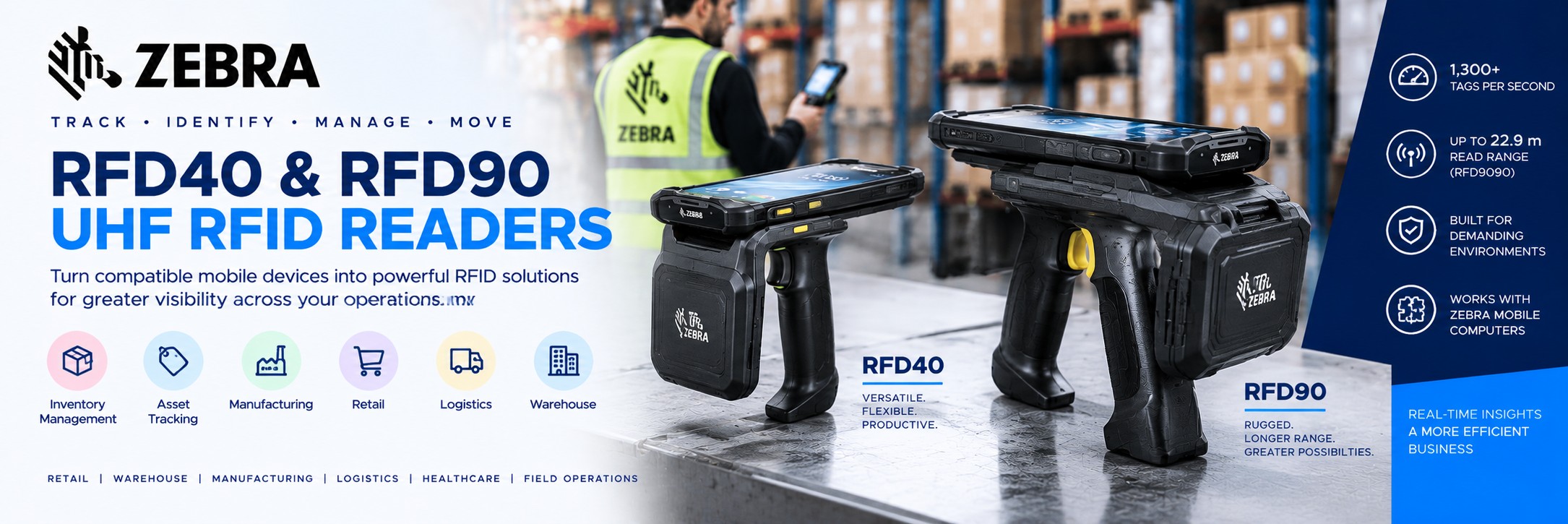
Zebra RFD40 & RFD90 UHF RFID Readers
The Zebra RFD40 and RFD90 families turn compatible mobile devices into powerful handheld UHF RFID solutions for inventory, asset tracking, retail, warehousing, manufacturing and logistics.
Both families can read more than 1,300 RFID tags per second. The main decision is whether you need the versatile everyday performance of the RFD40 or the greater ruggedness and extended-range options of the RFD90.
Already know the exact Zebra MPN? Send us the part number and quantity and we'll quote the configuration you need.
RFD40 or RFD90?
VERSATILE EVERYDAY RFID
Zebra RFD40
A versatile UHF RFID sled family for inventory, retail, stockrooms, warehouses, asset tracking and general business RFID applications.
- 1,300+ tag reads per second
- Approximately 6 m nominal read range on standard RFD40
- 7,000 mAh battery
- IP54 sealing on standard RFD40
- Multiple connectivity options across the RFD40 family
- Designed to pair with compatible mobile devices
Choose RFD40 when: you need fast handheld RFID for everyday inventory and asset workflows without requiring the extreme ruggedness or very long read range of the RFD90.
ULTRA-RUGGED RFID
Zebra RFD90
An ultra-rugged RFID sled family for demanding warehouse, manufacturing, logistics, yard and industrial environments.
- 1,300+ tag reads per second
- RFD9030 standard-range option
- RFD9090 long-range option
- Up to approximately 22.9 m nominal range with RFD9090
- IP65/IP67 sealing
- Multiple 1.8 m drops to concrete
Choose RFD90 when: ruggedness, harsh working conditions or long-distance RFID tag reading are major requirements.
Zebra RFD40 vs RFD90
| Feature | Zebra RFD40 | Zebra RFD90 |
|---|---|---|
| RFID Technology | UHF RAIN RFID | UHF RAIN RFID |
| Maximum Read Rate | 1,300+ tags/sec | 1,300+ tags/sec |
| Nominal Read Range | Approx. 6+ m on standard RFD40 | Approx. 6.7 m RFD9030 or up to approx. 22.9 m RFD9090 |
| Battery | 7,000 mAh | 7,000 mAh |
| Sealing | IP54 on standard RFD40 | IP65 / IP67 |
| Drop Rating | Multiple 1.5 m drops to concrete | Multiple 1.8 m drops to concrete |
| Best For | Retail, inventory, stockrooms, general warehouse and asset tracking | Industrial, warehouse, manufacturing, logistics, outdoor and long-range applications |
Simple rule: start with the RFD40 for mainstream handheld RFID. Move to the RFD90 where the working environment is tougher or the RFD9090's much longer RFID read range is required.
Zebra RFD40 Models
RFD40 is a product family rather than one single specification. The exact connectivity and barcode-scanning capabilities depend on the version selected.
STANDARD
RFD40 Standard
The core RFD40 UHF RFID sled for fast handheld RFID reading with compatible Zebra mobile computers and supported host devices.
Good for:
- Stock counts
- Inventory management
- Retail stockrooms
- Warehouse inventory
- Asset tracking
WIRELESS CONNECTIVITY
RFD40 Premium
Adds wireless capabilities including Bluetooth and Wi-Fi to support a wider range of connectivity and device-management requirements.
Consider Premium when:
- Bluetooth connectivity is required
- Wireless device management matters
- You need more deployment flexibility
RFID + BARCODE
RFD40 Premium Plus
Adds barcode scanning capability alongside RFID, allowing compatible configurations to support both technologies from the same handheld setup.
Consider Premium Plus when:
- You need RFID and barcode capture
- Workers handle mixed identification workflows
- You want to reduce separate handheld devices
Check the full MPN. Don't assume every product carrying the RFD40 name has identical connectivity or scanning capabilities.
Zebra RFD9030 vs RFD9090
Within the RFD90 family, the biggest distinction is RFID read range.
STANDARD RANGE
Zebra RFD9030
The RFD9030 provides the ultra-rugged construction of the RFD90 family with a nominal RFID read range of approximately 6.7 metres.
Best suited to:
- Industrial inventory
- Warehouse stock counts
- Manufacturing
- Asset tracking
- Harsh working environments
LONG RANGE
Zebra RFD9090
The RFD9090 is the long-range member of the family, with Zebra specifying a nominal RFID read range of approximately 22.9 metres.
Best suited to:
- Large warehouses
- Yards
- High shelving
- Long-distance asset searches
- Applications where approaching every tagged item is impractical
What Can You Do With a Handheld RFID Reader?
Cycle Counting
Walk through a stockroom or warehouse and capture compatible RFID tags without individually aligning every item with a barcode scanner.
Item Finding
Use RFID data to help locate tagged products, assets or equipment within an operational area.
Inventory Management
Capture RFID-tagged inventory during stock checks, replenishment and other inventory processes.
Asset Tracking
Identify tagged tools, IT equipment, reusable assets, machinery or other business equipment.
Goods Receiving
Use handheld RFID as part of workflows for verifying tagged products or assets entering a facility.
Retail Stock Control
Support stock counts, back-of-store management, item finding and inventory visibility in RFID-enabled retail environments.
Why Use RFID Instead of Scanning Every Barcode?
A conventional barcode scanner normally requires the operator to locate and present each barcode to the scanner.
UHF RFID works differently. Compatible RFID tags can be detected using radio-frequency technology without requiring the same direct visual alignment.
Barcode Scanning
- Individual barcode normally needs to be visible
- Very widely used
- Low-cost identification technology
- Excellent for individual transactions
- Simple and established workflows
UHF RFID
- No equivalent line-of-sight requirement
- Multiple compatible tags can be detected rapidly
- Useful for stock counts and asset searches
- Requires RFID tags and compatible software
- Performance depends on tags and environment
Many businesses use both barcode and RFID. RFID does not have to replace every barcode workflow.
RFD40 & RFD90 for Warehousing
Handheld RFID can be particularly useful where employees need to take the reader directly to stock rather than relying on products moving through a fixed RFID portal.
Cycle counts
Move through warehouse locations while reading tagged inventory.
Move through warehouse locations while reading tagged inventory.
Item searches
Use RFID to help locate tagged stock or assets.
Use RFID to help locate tagged stock or assets.
Inventory verification
Check RFID-tagged inventory against expected stock information.
Check RFID-tagged inventory against expected stock information.
Goods movement
Capture tagged items during operational warehouse processes.
Capture tagged items during operational warehouse processes.
Asset management
Identify tagged tools, equipment and reusable assets.
Identify tagged tools, equipment and reusable assets.
Long-range applications
Consider RFD9090 where additional RFID read range is operationally useful.
Consider RFD9090 where additional RFID read range is operationally useful.
RFD40 & RFD90 for Retail
Retail is one of the major applications for handheld UHF RFID.
Employees can use compatible Zebra RFID sleds for applications including:
Stock counts
Count RFID-tagged merchandise across sales-floor and stockroom areas.
Count RFID-tagged merchandise across sales-floor and stockroom areas.
Item finding
Help locate tagged products that should be present in store.
Help locate tagged products that should be present in store.
Inventory management
Support more frequent visibility of RFID-tagged stock.
Support more frequent visibility of RFID-tagged stock.
Back-of-store operations
Use handheld RFID in receiving, replenishment and stockroom workflows.
Use handheld RFID in receiving, replenishment and stockroom workflows.
RFD40 & RFD90 for Asset Tracking
RFID isn't limited to retail inventory. Handheld readers can also support asset-management applications.
IT Equipment
Identify RFID-tagged computers, devices and other technology assets.
Tools & Equipment
Track tagged tools and operational equipment across storage and working areas.
Reusable Assets
Identify tagged containers, cases, equipment and other reusable business assets.
RFID Read Range: What the Numbers Really Mean
Manufacturer read-range figures are useful for comparing hardware, but they should not be treated as a guaranteed distance in every deployment.
Actual RFID performance can be affected by:
RFID tag
Different tag designs can produce very different results.
Different tag designs can produce very different results.
Tag placement
Where the tag sits on the product or asset can affect performance.
Where the tag sits on the product or asset can affect performance.
Materials
Metal, liquids and other surrounding materials can influence RFID behaviour.
Metal, liquids and other surrounding materials can influence RFID behaviour.
Environment
Shelving, equipment, walls and nearby objects can alter real-world results.
Shelving, equipment, walls and nearby objects can alter real-world results.
Reader configuration
Power and software settings can affect the way tags are detected.
Power and software settings can affect the way tags are detected.
Orientation
Reader and tag orientation can influence achievable range.
Reader and tag orientation can influence achievable range.
For a business-critical RFID deployment, test the reader and intended tags in the actual operating environment rather than choosing hardware solely from a maximum range figure.
RFD40/RFD90 or a Fixed RFID Reader?
Choose a Handheld RFID Reader
Use an RFD40 or RFD90 when the employee moves to the tagged items.
Examples:
- Stock counts
- Asset searches
- Retail inventory
- Warehouse audits
- Equipment checks
Choose Fixed RFID
Consider fixed RFID infrastructure when the tagged items move through a known read point.
Examples:
- Dock doors
- Warehouse portals
- Production checkpoints
- Conveyor areas
- Controlled entrances or exits
Some RFID deployments use both handheld and fixed readers.
Check Your Mobile Computer Compatibility
RFD40 and RFD90 sleds can form part of a combined Zebra mobile-computing and RFID solution, but compatibility depends on the exact reader, connection method, adaptor and host device.
Zebra's eConnex system supports compatible Zebra mobile computers, while selected models also provide USB and/or wireless connectivity.
Don't order the sled from the family name alone. Check the complete reader MPN, the mobile computer being used, required adaptor, charging arrangement and connectivity before purchasing.
Frequently Asked Questions
What is the difference between Zebra RFD40 and RFD90?
The RFD40 is designed as a versatile handheld UHF RFID family for mainstream inventory and asset applications. The RFD90 provides greater environmental protection and ruggedness, with the RFD9090 also offering substantially greater nominal RFID read range.
How fast can the RFD40 and RFD90 read RFID tags?
Zebra specifies read rates of more than 1,300 tags per second for both families.
How far can the Zebra RFD40 read RFID tags?
Zebra specifies a nominal read range of approximately 6 metres or more for the standard RFD40. Actual range depends on the tag, environment, orientation and configuration.
How far can the Zebra RFD90 read RFID tags?
Zebra specifies approximately 6.7 metres nominal range for the RFD9030 and approximately 22.9 metres for the long-range RFD9090. Real-world performance varies according to the RFID deployment.
Can the RFD40 scan normal barcodes?
Barcode capability depends on the RFD40 configuration. The Premium Plus family provides integrated barcode-scanning capability. Always check the complete MPN rather than assuming every RFD40 has the same features.
Does the RFD40 have Bluetooth?
Bluetooth availability depends on the model. RFD40 Premium and Premium Plus configurations provide wireless connectivity including Bluetooth. Check the exact product specification before ordering.
Is the Zebra RFD90 waterproof?
Zebra specifies IP65 and IP67 sealing for the RFD90 family. These are environmental protection ratings; always follow Zebra's operating and care guidance rather than treating the device as universally waterproof.
Which reader is best for warehouse stocktaking?
Both families can support warehouse stocktaking. RFD40 is a strong starting point for mainstream handheld RFID, while RFD90 is more appropriate where ruggedness, harsh environments or longer-range reading are important.
Buying Zebra RFD40 or RFD90 RFID Readers?
Browse the available Zebra RFID configurations below. If you already know the Zebra MPN and quantity you need, send them to Tek Direkt and we'll provide a price.
For larger RFID deployments, include the mobile computers you're using, the application and the type of RFID tags or assets involved.
No calls. No meetings. No messing about. Just another price to compare.