
Thermal vs Direct Thermal Printers: Which Is Best for Your Business?
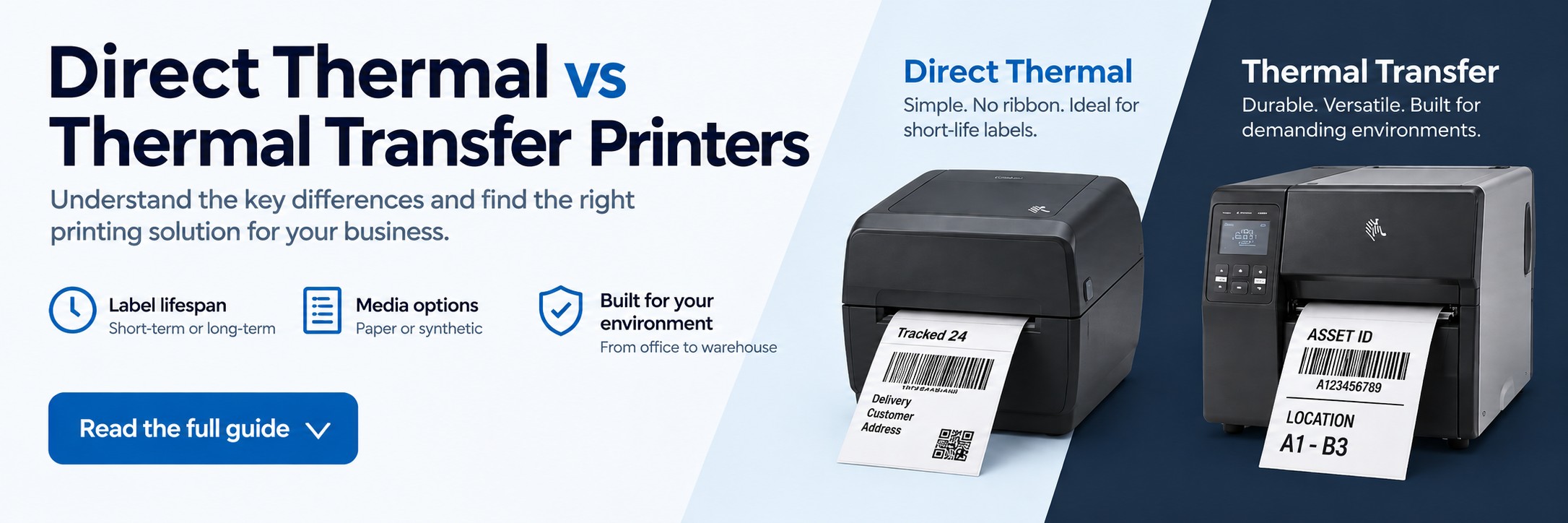
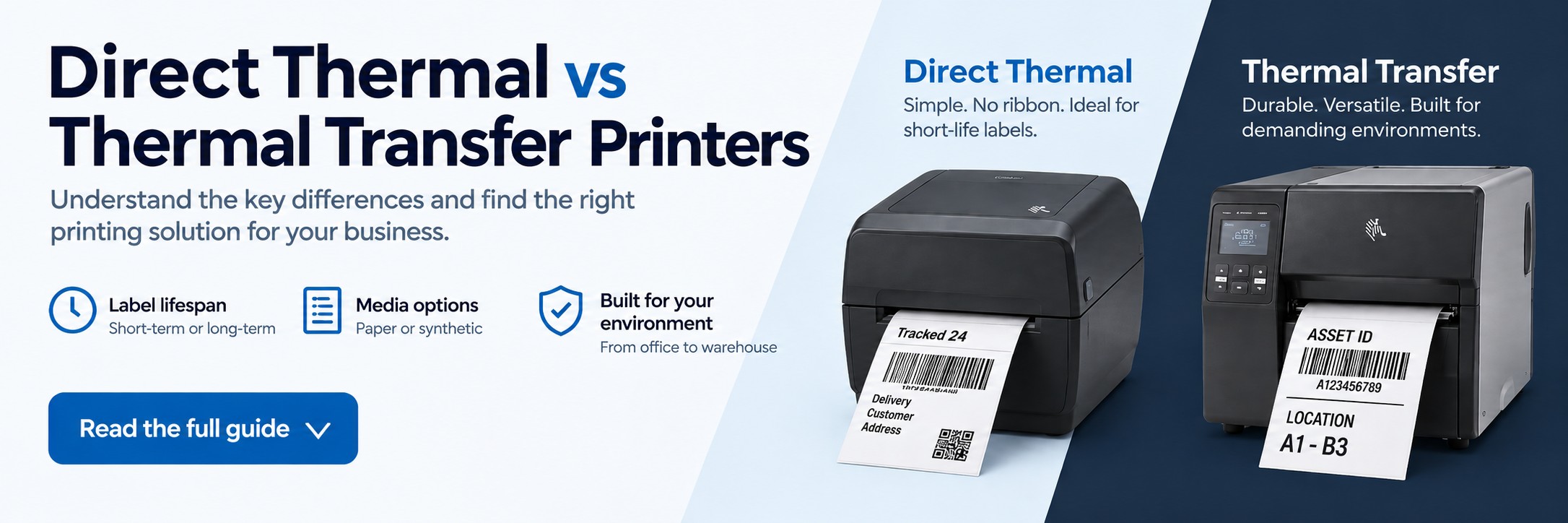
Direct Thermal vs Thermal Transfer Printers: Which Should You Choose?
Direct thermal and thermal transfer printers both use heat to produce labels, but they work in different ways. The most important difference is simple: direct thermal prints directly onto heat-sensitive labels, while thermal transfer uses a ribbon to transfer the printed image onto the label.
That difference affects label lifespan, durability, running costs and the types of materials you can print on. This guide explains which technology is better suited to your application.
Quick answer
Direct thermal or thermal transfer?
Choose direct thermal if...
- Your labels only need to last for a relatively short time
- You mainly print shipping or courier labels
- You want to avoid using printer ribbons
- Labels won't face significant heat, sunlight or harsh conditions
- Simplicity and ease of use are priorities
Choose thermal transfer if...
- Your labels need to remain readable for longer
- Labels may face abrasion, moisture or chemicals
- You need durable asset or product identification
- You want to print onto a wider choice of label materials
- You operate in manufacturing, warehousing or demanding environments
Still unsure? Think about how long the label needs to remain readable and what will happen to it after printing. Those two questions usually point you towards the right technology.
Printing method 1
What is direct thermal printing?
A direct thermal printer uses heat from the printhead to activate a specially coated, heat-sensitive label material. The image appears directly on the label, so there is no ink, toner or thermal-transfer ribbon.
This makes direct thermal printing particularly convenient for applications where labels have a relatively short working life.
No ribbon required
The printer only needs compatible direct thermal media, reducing the number of consumables that need to be changed.
Simple operation
With no ribbon to install or match to the label material, changing media can be quick and straightforward.
Ideal for short-life labels
Direct thermal is widely used where the label only needs to remain readable through a relatively short process such as delivery or dispatch.
What is direct thermal best used for?
Shipping labels
A strong fit for parcel and courier labels that only need to remain readable through the delivery process.
Courier labels
Common for carrier labels printed as orders are packed and dispatched.
Temporary inventory labels
Useful where identification is required for a relatively short period rather than permanent tracking.
Receipts
Direct thermal technology is also widely used in receipt and transaction printing applications.
Tickets
Suitable for many ticketing and short-term identification applications.
Short-life product labels
Can be suitable where the label will be used quickly and won't experience challenging environmental conditions.
The main limitation: direct thermal media is sensitive to heat and environmental conditions. The printed image can deteriorate over time, so it isn't normally the first choice for long-term identification.
Printing method 2
What is thermal transfer printing?
A thermal transfer printer also uses a heated printhead, but instead of reacting directly with the label material, the heat melts ink from a ribbon onto the label surface.
This allows thermal transfer printers to produce durable labels on a wider range of media, including paper and synthetic materials.
Longer-lasting print
Thermal transfer is better suited to labels that need to remain readable for extended periods.
More material choices
The technology can be used with a wide variety of paper and synthetic label materials when the media and ribbon are correctly matched.
Greater durability
Suitable media and ribbon combinations can provide better resistance to abrasion, moisture, chemicals and environmental exposure.
What is thermal transfer best used for?
Asset labels
Equipment and asset identification often needs to remain readable for months or years.
Warehouse labels
Bin, rack and location labels may need to withstand handling, abrasion and long periods in service.
Manufacturing labels
Products, components and work-in-progress labels can require more durable identification.
Product identification
Suitable where product labels need a longer lifespan than conventional direct thermal media can provide.
Healthcare & laboratory
Specialist materials can be used for applications where durability and reliable identification are important.
Compliance labels
Useful where regulatory, safety or traceability information needs to remain legible for an extended period.
Direct thermal vs thermal transfer: key differences
| Feature | Direct Thermal | Thermal Transfer |
|---|---|---|
| Ribbon required | No | Yes |
| Label media | Heat-sensitive direct thermal media | Paper and synthetic materials designed for thermal transfer |
| Typical label life | Better suited to short-term applications | Better suited to medium and long-term identification |
| Heat sensitivity | Higher | Depends on label and ribbon combination |
| Abrasion resistance | More limited | Can be significantly higher with suitable media and ribbon |
| Chemical resistance | Limited for many standard materials | Specialist combinations available for demanding applications |
| Consumables | Labels | Labels plus ribbon |
| Media choice | More limited | Wider range of materials |
| Typical uses | Shipping, courier, tickets, temporary labels | Assets, manufacturing, warehousing, product identification |
Which is cheaper to run?
It is tempting to assume direct thermal is always cheaper because it doesn't require a ribbon. In practice, the best-value option depends on the application rather than the price of one consumable.
Direct thermal costs
You don't need to purchase ribbons, which simplifies consumables and can make direct thermal attractive for high-volume short-life labels.
However, you must use direct thermal label media, and replacing labels that fade or become unreadable can outweigh the initial saving if the application really requires greater durability.
Thermal transfer costs
Thermal transfer requires both labels and ribbons, so there is an additional consumable to purchase and manage.
For long-life applications, however, the improved durability can make thermal transfer the more appropriate and economical choice overall.
Choose for the application first, then compare costs. The cheapest label to print isn't necessarily the cheapest label if it has to be replaced.
Label material matters as much as the printer
Choosing between direct thermal and thermal transfer is only part of the decision. The actual label material also needs to suit the product and environment.
Paper labels
A common and economical option for general labelling where high levels of environmental resistance aren't required.
Synthetic labels
Materials such as polypropylene and polyester can provide greater durability for demanding applications when paired with the appropriate printing method and ribbon.
Adhesive
Permanent, removable, freezer and specialist adhesives are available for different surfaces and environmental conditions.
The correct combination depends on the surface the label is applied to, temperature, moisture, abrasion, chemicals and how long the label needs to remain attached and readable.
What ribbon does a thermal transfer printer need?
If you choose thermal transfer, the ribbon needs to be compatible with both the printer and the label material. Thermal-transfer ribbons are commonly grouped into three broad types.
Wax ribbons
Often used with paper labels for general-purpose barcode, shipping, inventory and product identification.
They are typically the most economical ribbon type but provide less resistance to abrasion and chemicals than more durable formulations.
Wax/resin ribbons
Provide greater durability than standard wax and can be suitable for coated papers and some synthetic materials.
They offer a useful balance between cost and resistance for many warehouse and product-labelling applications.
Resin ribbons
Designed for demanding applications, particularly when printing onto compatible synthetic materials.
Suitable combinations can offer high resistance to abrasion, moisture and chemicals.
Don't choose a ribbon by colour or size alone. The ribbon formulation, label material and printer all need to be compatible.
How to choose between direct thermal and thermal transfer
How long must the label last?
For short-term labels, direct thermal may be sufficient. Long-term identification generally points towards thermal transfer.
Will it be exposed to heat or sunlight?
Environmental exposure can be an important limitation for direct thermal media.
Could the label get wet?
Consider moisture, condensation, refrigeration, outdoor use and cleaning processes.
Will it be rubbed or handled?
Labels on reusable containers, warehouse locations and assets may require better abrasion resistance.
Will chemicals touch the label?
Manufacturing, healthcare and laboratory environments may require specialist synthetic media and ribbons.
How many labels will you print?
Print volume also helps determine whether you need a desktop, industrial or mobile label printer.
Common mistakes when choosing a label printer
Choosing by printer price alone
The printer is only part of the system. Media, ribbons, print volume and label lifespan all affect the real cost.
Assuming direct thermal lasts indefinitely
Direct thermal is excellent for the right applications, but it is designed around heat-sensitive media and isn't suitable for every long-term use.
Buying the wrong thermal-transfer ribbon
Ribbon and label material need to be matched. An unsuitable combination can produce poor print quality or inadequate durability.
Ignoring printer duty cycle
A compact desktop printer may be ideal for hundreds of labels but unsuitable for a production environment printing thousands every day.
Choosing the wrong resolution
Small text, compact barcodes and detailed labels may benefit from higher print resolution than straightforward shipping labels.
Forgetting label width
Check the maximum print width and media dimensions before selecting a printer, particularly for wider shipping or pallet labels.
Desktop or industrial label printer?
Once you have chosen the printing method, the next decision is the type of printer.
Desktop label printers
Compact desktop models are suitable for many offices, retail operations, smaller warehouses and lower-to-medium volume applications.
Popular printer families include models such as the Zebra ZD Series and comparable desktop printers from Honeywell, TSC, Bixolon and other manufacturers.
Industrial label printers
Industrial printers are designed for higher print volumes, larger media capacities and more demanding warehouse and manufacturing environments.
They are generally a better fit where printers are operating heavily throughout the working day.
What if you need full-colour labels?
Direct thermal and thermal transfer technologies are primarily used for monochrome barcode, shipping, asset, inventory and industrial labels.
If your labels need full-colour branding, product photography, coloured warnings or changing product designs, a dedicated colour label printer may be more appropriate.
Inkjet colour label printers such as the Epson ColorWorks range allow businesses to print full-colour labels on demand, which can be particularly useful for food and drink, cosmetics, chemical identification and short-run product labelling.
Printing barcode labels?
If the labels will contain barcodes for products, cartons, inventory or supply-chain applications, print quality and barcode readability are also important.
For businesses working with GS1 identifiers and barcode standards, our GS1 guide explains GTINs, barcode formats, print quality and common causes of barcode scanning problems.
Direct Thermal & Thermal Transfer Printers to Compare
Once you've chosen the right printing technology, compare suitable printer models. Some support direct thermal only, while others support both direct thermal and thermal transfer depending on the exact configuration.
Direct Thermal Label Printers
TSC DA220
A desktop direct thermal printer for shipping, courier, inventory and short-life barcode labels.
Honeywell PC45D
A professional desktop direct thermal printer for retail, healthcare, logistics and business identification.
Bixolon XD3-40d
A compact desktop direct thermal label printer for shipping, stock identification and general barcode labelling.
Thermal Transfer & Dual-Technology Label Printers
The following printer families include thermal-transfer configurations. Many also support direct thermal printing, providing flexibility for businesses producing both short-life and durable labels.
Zebra ZD421
Available in direct thermal and thermal transfer configurations. Check the exact model before ordering.
Zebra ZD621
A premium desktop printer family with direct thermal and thermal transfer options.
TSC TE200
A desktop thermal transfer printer that also supports direct thermal printing for suitable applications.
Zebra ZT231
An industrial label printer with thermal transfer configurations for manufacturing and warehouse labelling.
Zebra ZT411
A configurable industrial printer supporting direct thermal and thermal transfer label production.
TSC MH241
An industrial thermal transfer printer that also supports direct thermal printing for compatible media.
Honeywell PM45
An industrial printer platform supporting direct thermal and thermal transfer applications.
Bixolon XT5-40
An industrial thermal label printer for warehouse, manufacturing and distribution applications.
SATO CL4NX Plus
An industrial printer supporting direct thermal and thermal transfer printing for demanding identification applications.
Label printing equipment from Tek Direkt
Tek Direkt supplies desktop, industrial and mobile label printing hardware from leading manufacturers including Zebra, Honeywell, TSC, Bixolon and others.
Label printers
Browse direct thermal and thermal transfer printers for shipping, barcode, product, warehouse and industrial labelling.
Labels & media
Choose compatible barcode labels and printer media for your labelling application.
Thermal ribbons
Wax, wax/resin and resin thermal-transfer ribbons for compatible label printers and media.
Not Sure Which Thermal Label Printer You Need?
Our interactive Label Printer Selector helps you compare suitable models based on your printing method, label size, expected print volume and application.
Explore direct thermal and thermal transfer printers from Zebra, TSC, Honeywell, Bixolon and SATO.
Already know which printer you need?
Send us the manufacturer part number and quantity, or forward an existing supplier quote.
We'll give you another price to compare. No calls or meetings needed.