We use cookies to make your experience better.
To comply with the new e-Privacy directive, you agree to the privacy policy and our use of cookies.

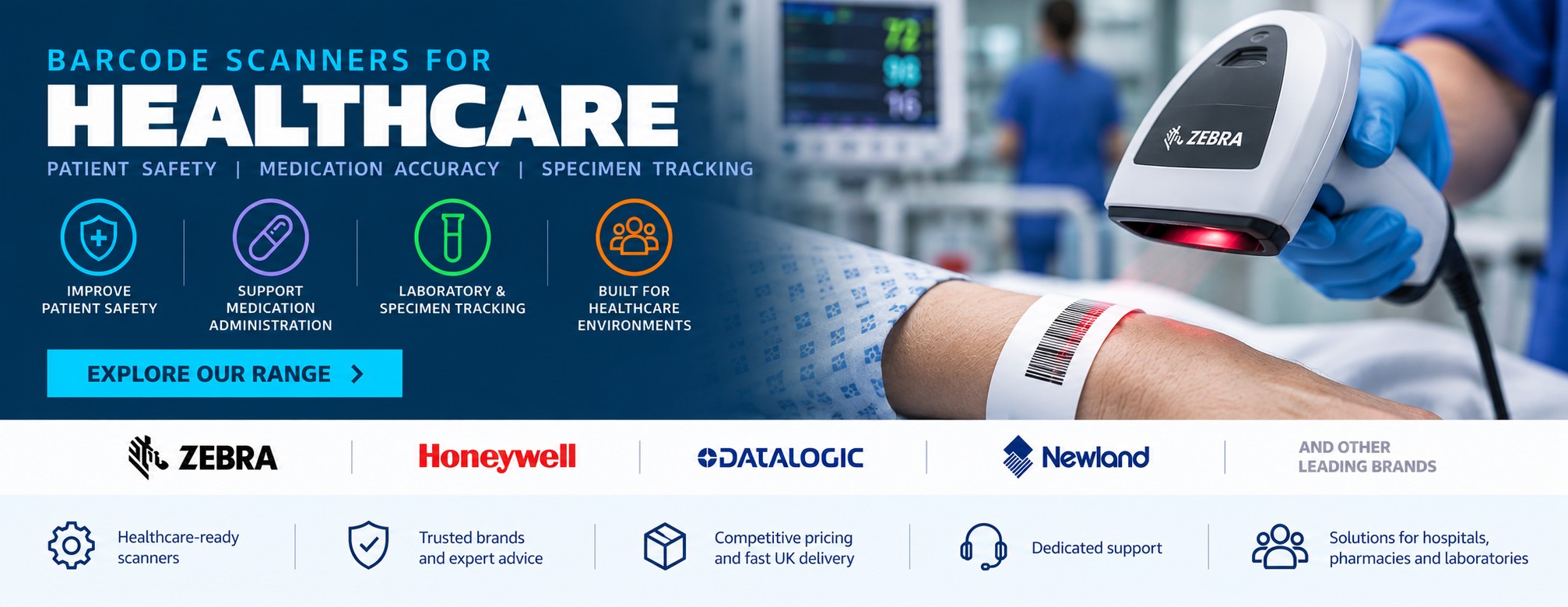
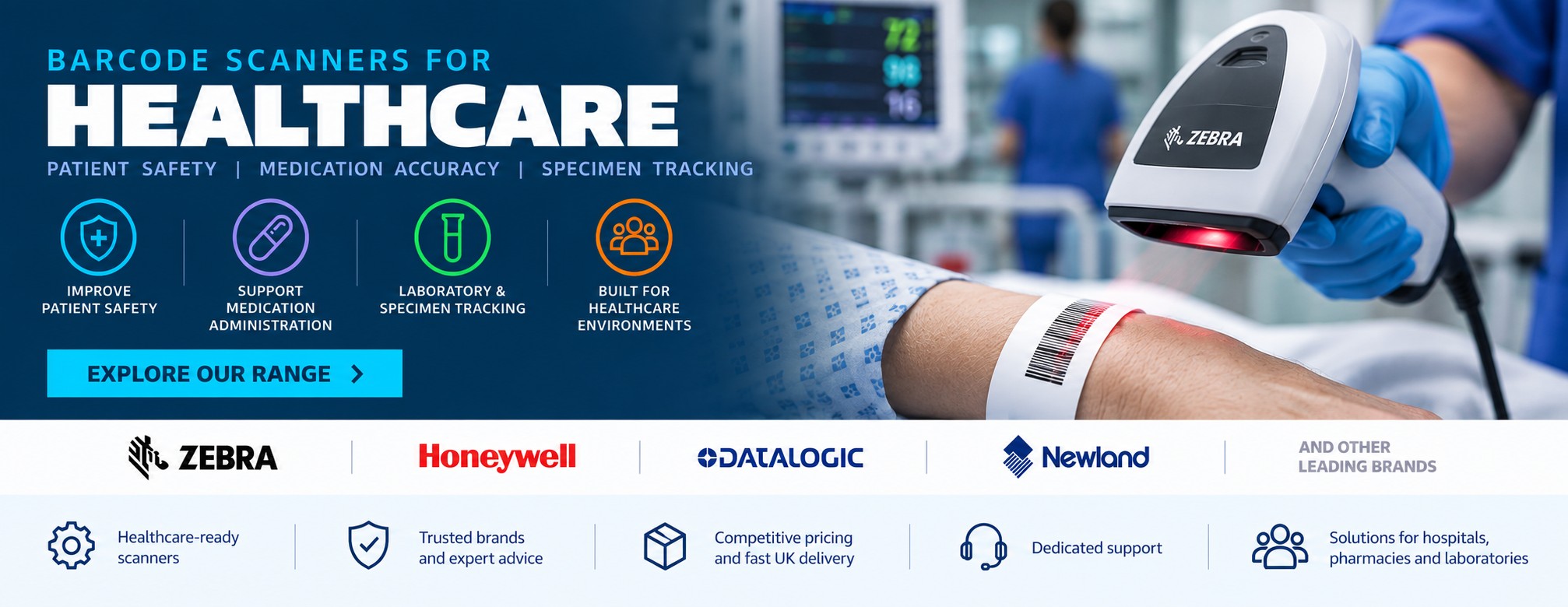
Barcode Scanners for Healthcare
Barcode scanning plays an important role throughout modern healthcare, helping organisations accurately identify patients, medication, samples, equipment and other critical items.
Tek Direkt supplies barcode scanners for hospitals, pharmacies, laboratories, clinics and other healthcare environments, including specialist healthcare-ready scanners designed for frequent cleaning and demanding clinical workflows.
From scanning a patient wristband at the bedside to checking medication or identifying a laboratory specimen, choosing the right scanner can help make everyday data capture faster, easier and more reliable.
Barcode Scanning Throughout Healthcare
Healthcare barcode scanners can be used across a wide range of clinical and operational workflows.
Common applications include:
- Patient identification
- Barcode wristband scanning
- Medication administration
- Pharmacy workflows
- Laboratory and specimen identification
- Blood bag and sample tracking
- Medical device and asset identification
- Inventory and stock control
- Admissions and administration
- Point-of-care data capture
The right scanner depends not only on the barcode being read, but also where and how the device will be used.
Patient Identification & Wristband Scanning
Patient identification is one of the most important barcode applications within healthcare.
Barcode scanners can be used to read patient wristbands at admission, bedside and other points of care, allowing information encoded within the barcode to be captured quickly and accurately.
Healthcare environments may require scanners capable of reading both traditional 1D barcodes and increasingly common 2D codes.
When selecting a scanner for patient identification, consider its barcode capability, ergonomics, cleaning requirements and whether corded or cordless operation is more appropriate for the workflow.
Barcode Scanners for Medication Administration
Barcode scanning can also form part of medication administration workflows.
Scanning patient identification alongside barcoded medication allows healthcare systems to capture information electronically rather than relying solely on manual data entry.
Depending on the application, scanners may need to read barcodes from medication packaging, labels, patient wristbands and computer or mobile-device screens.
A versatile 2D healthcare scanner is therefore often preferable where multiple barcode formats and surfaces are encountered.
Pharmacy Barcode Scanners
Pharmacies use barcode scanning for applications including prescription processing, medication identification, inventory management and stock control.
A pharmacy scanner may spend much of its working life at a fixed workstation, making a corded handheld or presentation-style scanner suitable for many applications.
Other workflows may benefit from cordless scanning where staff need greater freedom of movement.
The important thing is to choose the scanner around the actual pharmacy workflow rather than simply buying a general-purpose barcode scanner.
Laboratory & Specimen Barcode Scanning
Laboratories depend on accurate identification throughout specimen handling and processing.
Barcodes may be applied to:
- Specimen tubes
- Sample containers
- Laboratory labels
- Test requests
- Storage containers
- Racks and trays
These barcodes can be relatively small, making scanner performance and barcode resolution particularly important.
Where your application involves unusually small or specialist barcodes, check the exact scanner specification before ordering.
Healthcare Scanners Designed for Frequent Cleaning
A standard barcode scanner isn't necessarily the best choice for a clinical environment.
Healthcare-specific scanner models can use housings and materials designed to tolerate repeated cleaning with approved disinfectants.
This can be particularly important for devices shared between users or used around patients.
Always check the manufacturer's cleaning and disinfectant guidance for the exact scanner model being considered, as compatibility can differ between products.
Healthcare Scanner or Standard Barcode Scanner?
Not every healthcare application necessarily requires a specialist healthcare scanner.
A scanner used in a back-office stockroom, for example, may have very different requirements from one used repeatedly at a patient's bedside.
For clinical environments, healthcare-specific models can provide important advantages such as appropriate housing materials, healthcare-focused operating features and designs intended for frequent cleaning.
For general administrative or stock-control applications away from clinical areas, a conventional business barcode scanner may sometimes be sufficient.
The application should determine the hardware.
1D or 2D Barcode Scanners for Healthcare?
Many healthcare organisations need to read several different types of barcode.
1D scanners are suitable where only traditional linear barcodes need to be captured.
2D scanners can read both common 1D barcodes and 2D symbologies such as Data Matrix and QR codes, depending on the particular model.
They can also provide greater flexibility where barcodes need to be captured from electronic displays as well as printed labels.
For new healthcare deployments, a 2D imager is therefore often the more versatile choice.
For more information about scanner technologies and specifications, read our Barcode Scanner Buyer's Guide.
Scanning Barcodes from Screens
Healthcare workflows increasingly involve computers, tablets and mobile devices.
A suitable 2D imager can capture supported barcodes displayed electronically, allowing information to move between digital and physical workflows without requiring every code to be printed first.
If screen scanning is required, check this capability against the exact scanner configuration before purchasing.
Corded Barcode Scanners for Healthcare
Corded scanners can be a practical choice at permanent workstations such as:
- Pharmacy counters
- Laboratory benches
- Reception and admissions desks
- Administration areas
- Fixed clinical workstations
USB connectivity makes deployment straightforward in many environments, while a physical cable removes the need to manage batteries or charging.
Cordless Barcode Scanners for Healthcare
Cordless scanners provide greater freedom where the scanner needs to move around a workstation, trolley, bedside or clinical area.
Bluetooth and other wireless configurations are available across many scanner ranges.
When comparing cordless healthcare scanners, consider:
- Wireless range
- Battery life
- Charging arrangements
- Cradle requirements
- Cleaning requirements
- Host-device compatibility
Check the complete manufacturer part number when ordering, as scanners within the same product family can have different interfaces, accessories and regional configurations.
Handheld & Presentation Scanning
Healthcare scanning doesn't always mean picking up a scanner.
Handheld scanners provide flexibility for scanning wristbands, medication, specimens and other items from different angles.
Presentation scanners provide hands-free scanning at a fixed workstation. They can be useful where items are repeatedly presented to the scanner, such as certain pharmacy, reception or administrative applications.
Some handheld scanners can also operate in presentation mode when placed in a suitable stand or cradle.
Barcode Scanners for Hospitals
Hospitals can have dozens of different barcode scanning requirements within the same organisation.
A scanner suitable for a reception desk may not be appropriate for a ward, laboratory or pharmacy.
Typical hospital applications can include:
- Patient admissions
- Patient identification
- Medication workflows
- Pharmacy
- Pathology and laboratories
- Specimen identification
- Inventory
- Asset tracking
- Stores and supplies
For larger deployments, it can therefore make sense to standardise around a smaller number of scanner families while selecting configurations appropriate to each environment.
Zebra Healthcare Barcode Scanners
Zebra Technologies offers barcode scanners specifically designed for healthcare applications alongside its wider general-purpose scanner portfolio.
Healthcare-focused Zebra scanners are designed for workflows such as patient identification and medication tracking, with models intended to withstand repeated cleaning and operate appropriately within clinical environments.
When comparing Zebra healthcare scanners, check the exact model and MPN carefully because configurations can vary by connectivity, included accessories and scanning capability.
Honeywell Barcode Scanners for Healthcare
Honeywell produces barcode scanning hardware used across healthcare, retail, logistics and industrial applications.
Depending on the model, Honeywell scanners can support applications ranging from fixed pharmacy and administration workstations to mobile clinical workflows.
If you are replacing existing Honeywell hardware, send us the exact MPN and quantity and we can help source the appropriate configuration.
Barcode Scanners for Healthcare Stock & Inventory
Healthcare organisations also need to manage large quantities of non-patient inventory.
Barcode scanning can support stock control for medical supplies, consumables, pharmacy inventory and other operational equipment.
These applications may not require a healthcare-specific scanner if the hardware is used away from clinical environments, which can widen the available choice considerably.
Barcode Scanner or Mobile Computer?
A barcode scanner captures information and passes it to another device or application.
A mobile computer combines scanning with a screen, processor, wireless connectivity and applications in a single handheld device.
Mobile computers can therefore be more appropriate where staff need to move around a facility while accessing information, updating records or completing workflows directly on the device.
Healthcare-specific mobile computers are also available for clinical mobility applications. Zebra, for example, has a dedicated healthcare mobile-computing portfolio.
We cover this in more detail in our dedicated Mobile Computers for Healthcare guide.
How to Choose a Healthcare Barcode Scanner
Before selecting a scanner, consider the complete workflow rather than just the barcode itself.
Start with:
What will you scan?
Patient wristbands, medication, specimens, stock, assets or a combination?
Which barcode types are used?
1D, 2D or both?
Where will the scanner operate?
Bedside, pharmacy, laboratory, reception, office or stockroom?
Does it require frequent disinfecting?
If so, look specifically at healthcare-ready models and manufacturer-approved cleaning guidance.
Corded or cordless?
Fixed workstations may suit corded scanners, while bedside and mobile workflows can benefit from cordless operation.
Will you scan screens?
Choose a compatible 2D imager if electronic barcode capture is part of the workflow.
Are you replacing existing equipment?
Check the full MPN rather than relying on the product family name.
Build a Complete Healthcare Data Capture Solution
Barcode scanners are only one part of healthcare identification.
Depending on the application, a complete solution may also include:
- Healthcare label printers
- Patient wristband printers
- Mobile computers
- Barcode labels and media
- Charging cradles
- Scanner stands
- Replacement batteries
- Cables and accessories
Check out our other resources around these applications, including Label Printers for Healthcare and Mobile Computers for Healthcare.
Buy Barcode Scanners for Healthcare
Tek Direkt supplies barcode scanning and data-capture hardware for healthcare organisations across the UK.
Whether you need a scanner for a pharmacy workstation, patient identification, laboratory workflow, inventory application or a larger hardware deployment, we can help you compare suitable options from leading manufacturers.
Already know what you need?
Send us the manufacturer part number and quantity and we'll price the exact configuration.
Already have a supplier quote? Use Beat My Quote and give us the opportunity to provide another price:

