We use cookies to make your experience better.
To comply with the new e-Privacy directive, you agree to the privacy policy and our use of cookies.

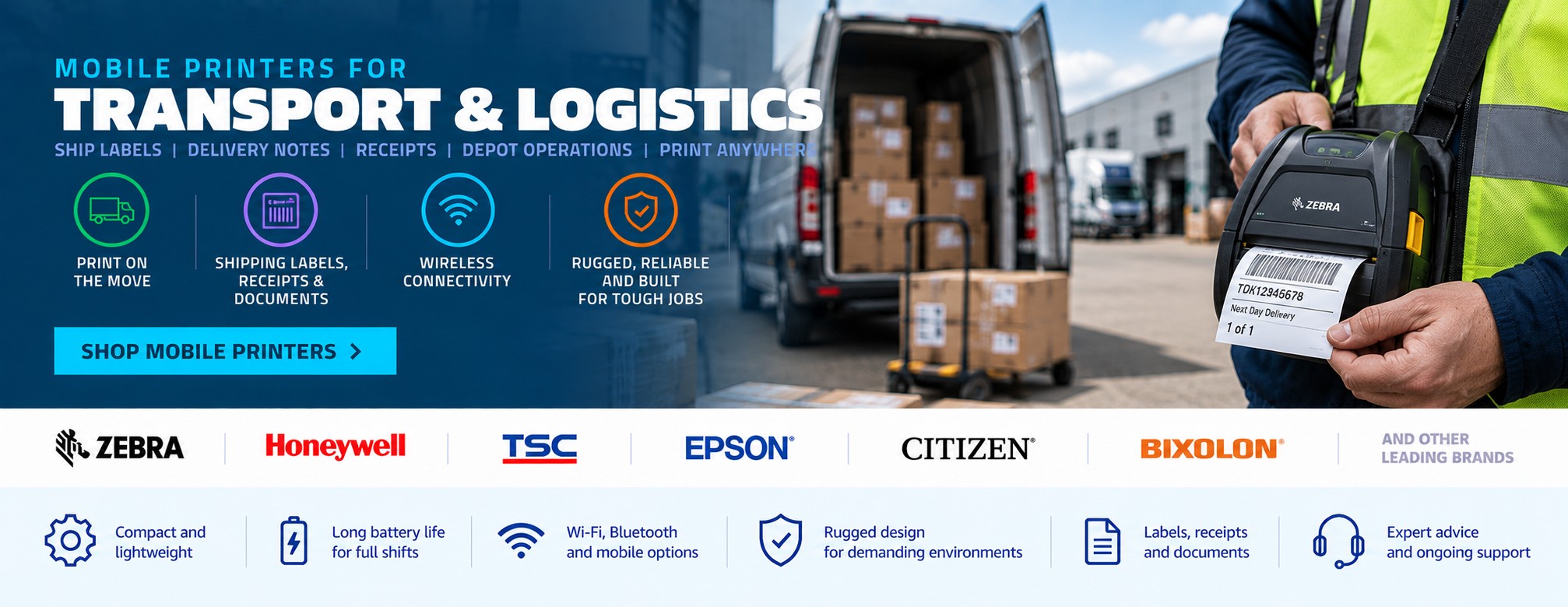
Mobile Printers for Transport & Logistics
Mobile printers allow transport and logistics teams to produce labels, receipts and documents at the point of activity, rather than returning to a fixed printing station.
Tek Direkt supplies mobile printers for transport, logistics, distribution and delivery operations from Zebra and other leading manufacturers, with compact wireless devices designed for depot, warehouse, vehicle and field-based workflows.
Whether you need to print a replacement shipping label at a loading bay, produce documentation during a delivery or generate labels while moving around a distribution operation, mobile printing can help bring the printing process closer to where the work actually happens.
Mobile Printing Across Transport & Logistics
Transport and logistics operations can involve printing at many different stages.
Typical applications include:
- Shipping labels
- Parcel labels
- Consignment labels
- Replacement labels
- Inventory labels
- Pallet and carton identification
- Delivery documentation
- Collection documentation
- Receipts
- Returns labels
- Depot labelling
- Yard operations
The appropriate printer depends on what needs to be printed, where it will be used and how mobile the operator needs to be.
Print Labels at the Point of Activity
A fixed printer works well when employees bring the work to a permanent printing station.
Mobile printing reverses that process.
The printer travels with the worker so labels or documents can be produced close to the item, vehicle or customer.
This can be useful where employees move frequently between:
Goods → Pallets → Cages → Loading Bays → Vehicles → Delivery Locations
Reducing unnecessary movement back to a fixed printer can help simplify mobile workflows.
Mobile Printers for Shipping Labels
Shipping labels contain information required to identify and route goods through transport networks.
Where labels need to be generated or replaced away from a permanent print station, a mobile printer can provide a practical alternative.
Before choosing a printer for shipping labels, check:
- Required label width
- Print resolution
- Barcode requirements
- Media roll capacity
- Connectivity
- Expected print volume
- Required durability
Not every mobile printer can accommodate every shipping-label format, so media dimensions are particularly important.
Mobile Printers for Parcel & Consignment Labels
Parcel operations can require labels to be generated at different stages of the logistics process.
A mobile printer can allow an operator to print an identification or consignment label close to the parcel rather than taking the item to a central printer.
This can be particularly useful in dynamic workflows where parcels are processed across a large operational area.
Mobile printing can also help where a damaged or unreadable label needs to be replaced.
Mobile Printers for Depots
Depots often combine receiving, sorting, staging, loading, dispatch and returns operations.
Workers may need to move between these areas throughout a shift.
A mobile printer can support printing without tying the employee to a specific workstation.
Potential depot applications include:
- Re-labelling
- Returns
- Parcel identification
- Cage identification
- Inventory
- Dispatch
- Loading
- Exception processing
For intensive depot use, consider ruggedness, battery life and charging arrangements alongside print performance.
Mobile Printers for Delivery Drivers
Delivery and collection workflows can also benefit from mobile printing.
Depending on the business process, drivers may need to produce:
- Receipts
- Delivery documentation
- Collection documentation
- Labels
- Customer records
- Confirmation documents
A compact mobile printer can travel with the driver and communicate wirelessly with a mobile computer, tablet or other compatible host.
The exact workflow depends on the organisation's software and printing application.
Mobile Printers for Collections
Collection operations can require information to be generated when goods are collected rather than before the driver leaves the depot.
Mobile printing can allow documentation or identification labels to be produced at the collection point.
This can be particularly useful where information isn't known until the goods are physically collected.
Mobile Printers for Returns
Returns can create unexpected printing requirements.
An item may arrive with a damaged label, need a new internal identifier or require a new shipping label before being routed elsewhere.
Mobile printers can allow staff to produce the required label while processing the return.
Combined with barcode scanning or mobile computing, this can create a more flexible returns workflow.
Rugged Mobile Printers for Logistics
Mobile printers used in logistics can experience considerably more physical stress than printers sitting permanently on a desk.
Depending on the environment, devices may be exposed to:
- Drops
- Vibration
- Dust
- Moisture
- Temperature changes
- Frequent handling
- Vehicle use
Rugged mobile printers are designed to provide greater protection for these types of operating conditions.
Always compare the manufacturer's environmental and drop specifications against the actual application.
Wireless Mobile Printing
Wireless connectivity allows the printer to communicate with the device running the application.
Depending on the printer and configuration, connectivity may include:
- Bluetooth
- Wi-Fi
- USB
- NFC-assisted pairing
Bluetooth is commonly useful where the printer is paired directly with a handheld mobile computer or other nearby device.
Wi-Fi can be useful where printers need to communicate across an organisation's wireless network.
Check the exact MPN, as connectivity options can vary within the same printer family.
Mobile Printers & Mobile Computers
Mobile printers become particularly powerful when paired with a mobile computer.
The mobile computer can provide:
Barcode scanning + Application + Data + Connectivity
while the mobile printer provides:
Labels + Receipts + Printed Documentation
Together, the devices can support a complete mobile workflow without requiring the operator to return to a desktop workstation.
For devices used across depots, vehicles and delivery operations, see our Mobile Computers for Transport & Logistics.
Mobile Printers & Barcode Scanners
Not every operation needs a full mobile computer.
Where employees already use another host device, a barcode scanner and mobile printer can provide another approach.
For example, a worker might scan an existing parcel label and then produce a replacement label using a paired mobile printer.
For scanning hardware, see our Barcode Scanners for Transport & Logistics.
Direct Thermal Mobile Printing
Most mobile label and receipt printers use direct thermal printing.
Direct thermal printers create the printed image using heat-sensitive media and therefore don't require a thermal transfer ribbon.
This helps keep mobile printers compact and avoids the need for operators to carry and replace ribbons.
Direct thermal is particularly suitable for shorter-life logistics applications such as:
- Shipping labels
- Parcel labels
- Receipts
- Delivery documentation
- Temporary identification
Where labels need to remain readable for considerably longer or withstand demanding conditions, check whether direct thermal media is appropriate.
For more information, read our Thermal vs Direct Thermal Printing Guide.
Label Width & Media Capacity
One of the most important considerations when choosing a mobile printer is the required media size.
A compact receipt printer may not accommodate the same label dimensions as a larger rugged mobile label printer.
Before ordering, establish:
- Label width
- Label length
- Media thickness
- Roll diameter
- Required print width
- Expected labels per shift
This is particularly important when replacing an existing printer or trying to use an established label format.
Battery Life for Logistics Printing
Mobile printing relies on battery power, so runtime matters.
A printer used throughout a complete logistics shift needs sufficient capacity for the actual printing workload.
Consider:
- Battery capacity
- Expected print volume
- Charging time
- Replaceable batteries
- Spare batteries
- Multi-device chargers
- Vehicle charging
Large deployments should consider charging infrastructure at the same time as the printers themselves.
Vehicle-Based Mobile Printing
Some transport applications require printers to travel permanently or regularly in vehicles.
Vehicle-based deployments may require:
- Vehicle chargers
- Mounting options
- Protective cases
- Spare batteries
- Reliable wireless pairing
Consider how the printer will be stored and charged while the vehicle is moving.
Zebra Mobile Printers for Transport & Logistics
Zebra Technologies produces a broad range of mobile printers for transport, logistics, warehousing and field operations.
Its mobile printer portfolio includes compact devices for lighter printing requirements alongside rugged models designed for more demanding environments.
Relevant families include the ZQ300, ZQ500 and ZQ600 Series.
Always compare the complete manufacturer part number because connectivity, regional configuration, media handling and other specifications can vary.
Zebra ZQ521 Mobile Printer
The Zebra ZQ521 is particularly relevant to demanding transport and logistics applications.
It is part of Zebra's rugged ZQ500 Series and is designed for mobile printing where durability and portability are important.
Potential applications include:
- Shipping labels
- Parcel identification
- Depot operations
- Loading areas
- Inventory
- Field service
- Transport documentation
Different ZQ521 configurations are available, so check the full Zebra MPN before ordering.
If you already have a ZQ521 part number, send Tek Direkt the MPN and quantity and we can price the exact configuration.
Compact Mobile Printers
Not every application requires a heavily ruggedised printer.
For receipt printing, lighter-duty field work or applications where portability is the main requirement, a smaller mobile printer may be more suitable.
Compact printers can offer:
- Lower weight
- Easier belt carrying
- Smaller physical size
- Convenient Bluetooth connectivity
The trade-off may be smaller media capacity, narrower print width or reduced ruggedness compared with larger industrial mobile printers.
Mobile Printer Accessories
The printer itself is only part of a mobile deployment.
Depending on the application, accessories can include:
- Spare batteries
- Battery chargers
- Multi-slot charging stations
- Vehicle chargers
- Vehicle cradles
- Shoulder straps
- Belt clips
- Protective cases
- Spare media
For larger deployments, accessory compatibility should be checked before committing to a particular printer family.
Mobile Printing vs Fixed Label Printing
A mobile printer isn't automatically better than a fixed printer.
Choose a fixed desktop or industrial printer when:
- Printing happens at a permanent workstation
- Large media rolls are required
- Print volumes are high
- Operators don't need to move while printing
Choose a mobile printer when:
- Printing needs to happen near the goods
- Operators move around the facility
- Drivers need printing in the field
- Re-labelling occurs away from a workstation
- Portability is more important than very high print volume
For fixed warehouse printing requirements, see our Label Printers for Warehouses page.
How to Choose a Mobile Printer for Transport & Logistics
Before choosing a printer, establish the workflow.
What will you print?
Labels, receipts, delivery documents or several types of media?
What size is the media?
Check required print width and roll dimensions.
Where will the printer be used?
Depot, loading bay, yard, vehicle or customer location?
How rugged does it need to be?
Consider drops, dust, moisture and intensive daily use.
Which connectivity is required?
Bluetooth, Wi-Fi or wired connectivity?
What will the printer connect to?
Mobile computer, tablet, PC or another host?
How much will you print?
Expected print volume affects battery and media requirements.
How will devices be charged?
Consider depot and vehicle charging.
Do you already use a particular label format?
Check media compatibility before changing printer.
Build a Complete Transport & Logistics Workflow
A mobile printer can form part of a wider data-capture and identification system.
Depending on the operation, this might include:
- Mobile printers
- Mobile computers
- Barcode scanners
- Fixed label printers
- Barcode labels
- Charging equipment
- Vehicle cradles
- Spare batteries
- Wireless infrastructure
A typical workflow could therefore look like:
Scan consignment → Process information → Print label/document → Move goods → Confirm delivery
Tek Direkt supplies hardware across these areas from leading manufacturers.
Buy Mobile Printers for Transport & Logistics
Tek Direkt supplies mobile printers for transport, logistics, distribution, depot and delivery operations across the UK.
Whether you need a rugged printer for loading and depot operations, a compact device for field workers or a specific Zebra mobile printer configuration, we can help you compare suitable hardware.
Already know what you need?
Send us the manufacturer part number (MPN) and quantity and we'll price the exact configuration.
Already have another supplier's quote? Send us the same MPN and quantity through Beat My Quote.

