We use cookies to make your experience better.
To comply with the new e-Privacy directive, you agree to the privacy policy and our use of cookies.

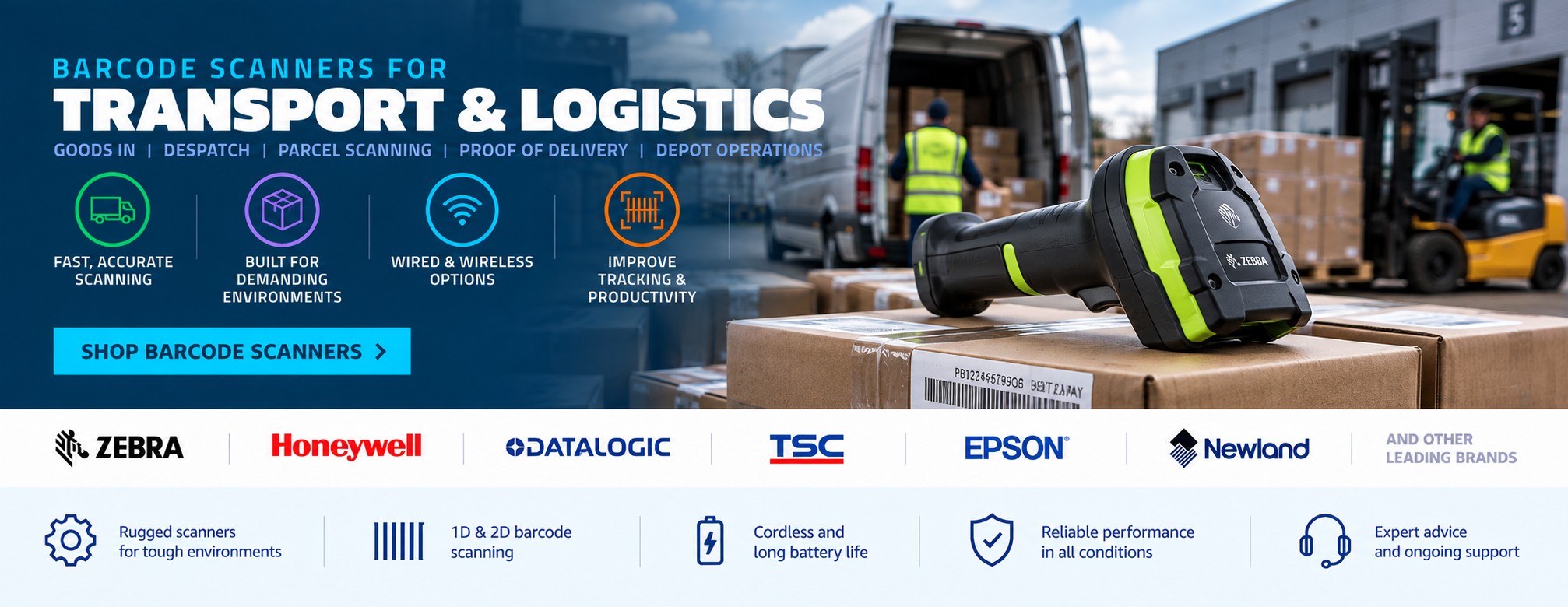
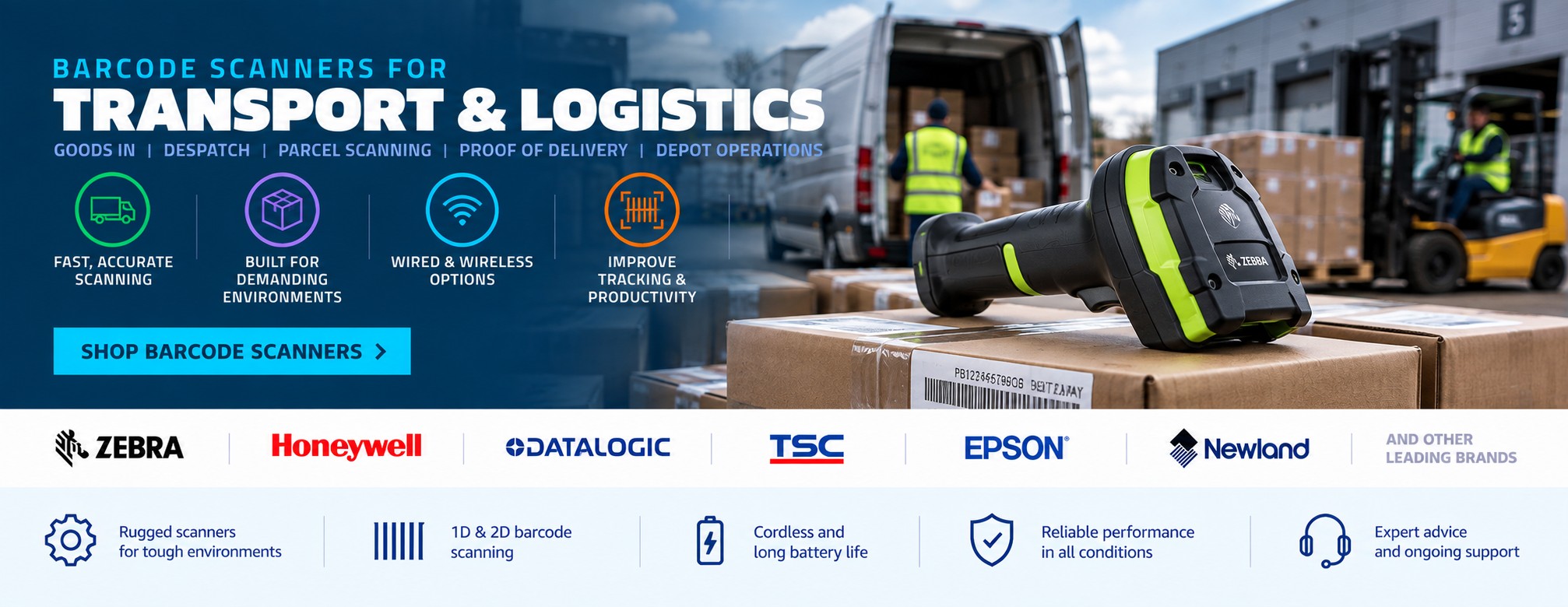
Barcode Scanners for Transport & Logistics
Fast, reliable barcode scanning helps transport and logistics businesses identify and track goods as they move between depots, warehouses, vehicles, distribution centres and delivery destinations.
Tek Direkt supplies barcode scanners for transport and logistics, including handheld, cordless and rugged scanners from Zebra, Honeywell, Datalogic and other leading manufacturers.
Whether you're scanning parcels at dispatch, checking goods onto a vehicle, processing incoming consignments or capturing barcodes in a busy depot, the right scanner can make barcode capture faster and more reliable.
Barcode Scanning Across Transport & Logistics
Barcode scanning can support goods throughout the logistics journey.
Common applications include:
- Goods receiving
- Parcel and consignment scanning
- Sorting
- Picking and dispatch
- Loading and unloading
- Depot operations
- Cross-docking
- Pallet identification
- Inventory checks
- Returns processing
- Proof-of-delivery workflows
- Track-and-trace processes
The best scanner depends on what you're scanning, where you're scanning it and how demanding the operating environment is.
Parcel & Consignment Barcode Scanning
Parcel operations can involve large numbers of barcodes being scanned throughout the working day.
Codes may appear on shipping labels, cartons, packages and consignment documentation, with varying print quality, orientation and condition.
A capable 2D imager can help capture common 1D and 2D barcode formats without requiring the operator to align the scanner as precisely as older laser-scanning technologies.
For higher-volume operations, ergonomics and scanning performance are particularly important because small delays can become significant across thousands of scans.
Barcode Scanners for Goods In
Incoming goods often need to be identified as soon as they arrive at a depot or distribution facility.
Barcode scanning can be used to capture:
- Product barcodes
- Shipping labels
- Carton identifiers
- Pallet labels
- Consignment numbers
- Supplier labels
Scanning at goods-in can help connect the physical arrival of goods with the organisation's warehouse, inventory or logistics system.
For operations where goods are subsequently stored and picked within a warehouse, also see our Warehouse Barcode Scanners.
Barcode Scanners for Dispatch
Dispatch is another high-volume scanning point.
Goods may need to be scanned before they are packed, assigned to a consignment, moved to a loading area or loaded onto a vehicle.
Reliable scanning can help operators confirm that the correct item or parcel is moving through the correct dispatch process.
The barcode scanner captures the identifier; what happens with that information depends on the warehouse, transport or logistics software being used.
Barcode Scanners for Loading & Unloading
Loading areas can be demanding environments for scanning hardware.
Operators may move between pallets, cages, cartons, loading bays and vehicles rather than remaining at a fixed workstation.
For these applications, cordless and rugged barcode scanners can be particularly useful.
Consider:
- Wireless range
- Battery runtime
- Drop resistance
- Dust and moisture protection
- Working distance
- Barcode size
- Scanner ergonomics
The appropriate specification depends on the actual operating environment.
Rugged Barcode Scanners for Logistics
A scanner used in a busy depot or loading area can experience significantly more physical stress than one used at a retail checkout.
Rugged scanners are designed for more demanding applications where equipment may be exposed to drops, impacts, dust, temperature changes or intensive daily use.
Models within ranges such as the Zebra DS3600 Series and industrial scanning families from Honeywell and Datalogic can be appropriate for tougher logistics environments.
Don't assume every logistics application requires the most rugged scanner available, however. Match the level of protection to the actual conditions.
Cordless Barcode Scanners for Transport & Logistics
Cordless scanners allow operators to work away from a fixed terminal.
This can be particularly useful for:
- Loading bays
- Large pallets
- Oversized goods
- Vehicle loading
- Cage scanning
- Goods receiving
- Returns
- Depot sorting
Bluetooth and other wireless technologies can provide different operating ranges depending on the scanner and host equipment.
Battery life and charging arrangements should also be considered where devices are used across long shifts.
Corded Barcode Scanners for Fixed Workstations
Corded scanners remain a strong option where scanning takes place at a permanent workstation.
Potential applications include:
- Dispatch desks
- Goods-in stations
- Parcel processing points
- Returns desks
- Administration areas
They remove the need to manage batteries and charging and can offer a straightforward connection to the host terminal.
For a fixed scanning point, paying for cordless capability may provide little practical benefit.
1D & 2D Barcode Scanning
Transport and logistics operations can encounter numerous barcode formats.
Modern 2D imagers can typically read traditional 1D barcodes as well as 2D codes such as QR Code and Data Matrix, depending on the scanner specification.
A 2D scanner can therefore provide greater flexibility where businesses need to capture different code types from labels, paperwork or screens.
Always check the scanner specification against any specialist barcode formats used within your operation.
Scanning Damaged & Poorly Printed Barcodes
Shipping and logistics labels don't always arrive in perfect condition.
Barcodes may be:
- Creased
- Dirty
- Partially damaged
- Poorly printed
- Low contrast
- Covered by reflective material
- Printed at unusual sizes
Higher-performance imaging scanners can offer improved decoding of challenging printed barcodes.
However, no scanner can compensate for every badly damaged code, so barcode quality and label-printing processes remain important.
Long-Range Barcode Scanning
Some logistics environments require barcodes to be read from greater distances.
For example, an operator may need to capture a barcode on:
- A pallet
- A warehouse rack
- A large carton
- A cage
- An item that is difficult to approach
Selected industrial scanners are available with extended-range scanning configurations.
Check the required minimum and maximum working distance, barcode size and barcode density before choosing an extended-range scanner.
Barcode Scanners for Distribution Centres
Distribution centres can combine many different scanning environments within one operation.
A single facility might require scanning at:
Goods In → Storage → Picking → Sorting → Packing → Dispatch → Loading
Different hardware can make sense at different stages.
A rugged cordless scanner may be appropriate around loading areas, while a standard handheld scanner may be sufficient at a fixed packing station.
For warehouse-specific picking and inventory requirements, visit our Warehouse Barcode Scanner article.
Barcode Scanners for Depots
Transport depots often need to process goods quickly as they arrive, move through sorting operations and leave for onward delivery.
Barcode scanners can help capture identifiers at each handover or processing point.
Important considerations include scanner durability, wireless freedom, battery life and the ability to capture barcodes quickly from parcels of different shapes and sizes.
Cross-Docking & Fast-Moving Goods
Cross-docking reduces the amount of time goods spend in storage by moving them rapidly between inbound and outbound operations.
In these environments, scanning speed and reliability can become particularly important because goods may pass through several processing stages within a short period.
Cordless scanning can provide greater freedom around pallets, cages and loading areas, while rugged devices may be appropriate where equipment is exposed to intensive use.
Barcode Scanning for Returns
Returns processing can require products, parcels or original shipping labels to be identified before goods can be inspected and routed.
A flexible 2D scanner can help capture different barcode formats encountered during this process.
Where returned labels are damaged or worn, scanner performance on lower-quality barcodes can become particularly relevant.
Proof of Delivery & Mobile Data Capture
For delivery operations, a dedicated barcode scanner isn't always the most appropriate device.
Drivers and mobile workers may need to:
- Scan parcels
- View delivery information
- Capture signatures
- Take photographs
- Access applications
- Communicate with the depot
- Use cellular connectivity
Where scanning is only one part of a wider mobile workflow, a mobile computer can be more appropriate than a standalone barcode scanner.
Zebra Barcode Scanners for Logistics
Zebra Technologies produces barcode scanners for applications ranging from fixed workstations to demanding industrial logistics environments.
Relevant product families can include standard handheld scanners alongside rugged DS3600 Series devices designed for tougher operating conditions.
When comparing Zebra scanners, check the complete manufacturer part number because scanning range, connectivity, ruggedness and included accessories can differ between configurations.
Honeywell Barcode Scanners for Logistics
Honeywell supplies handheld and industrial barcode scanning technology for logistics, warehousing and distribution applications.
Different Honeywell scanner families address requirements ranging from general-purpose barcode capture to more demanding industrial use.
Select the scanner around the actual barcode, working distance and environment rather than choosing by brand alone.
Datalogic Barcode Scanners for Logistics
Datalogic offers barcode scanning solutions for transport, logistics, manufacturing and warehouse applications.
Its handheld ranges include general-purpose and industrial devices, with cordless configurations available where operators need greater freedom of movement.
Check the exact model and MPN against the scanning requirement before ordering.
Handheld Scanner or Mobile Computer?
The distinction is important.
A barcode scanner primarily captures barcode data and passes it to another device or system.
A mobile computer combines barcode scanning with computing, a display, wireless connectivity and applications in a single handheld device.
A scanner can therefore be ideal at a workstation or where an operator already has a host device.
A mobile computer can make more sense for workers moving throughout a depot, yard or delivery operation who also need access to software and information.
Barcode Scanning & Logistics Label Printing
Scanning depends on readable barcode labels.
Transport and logistics businesses may need to produce:
- Shipping labels
- Parcel labels
- Pallet labels
- Inventory labels
- Consignment labels
- Returns labels
Where labels or documents need to be produced away from a fixed workstation, explore our Mobile Printers for Transport & Logistics page for mobile printing options for depots, loading areas, vehicles and delivery operations.
For warehouse label printing, see our Label Printers for Warehouses page.
How to Choose a Barcode Scanner for Transport & Logistics
Before choosing a scanner, consider:
What will you scan?
Parcels, products, cartons, pallets, cages or paperwork?
Which barcode formats are used?
1D, 2D or both?
Where will scanning happen?
At a desk, in a depot, on a loading bay, around vehicles or outdoors?
How rugged does the scanner need to be?
Consider drops, dust, moisture and intensive daily use.
Corded or cordless?
Think about how far operators need to move from the host device.
What working distance is required?
A pallet label several metres away is a different requirement from a parcel barcode held in the hand.
How intensive is the scanning workload?
Ergonomics become increasingly important in high-volume operations.
Do workers need applications as well as scanning?
If yes, consider a mobile computer instead.
Build a Complete Transport & Logistics Data Capture Solution
Barcode scanners are often one component of a wider logistics technology setup.
Depending on the operation, businesses may also require:
- Mobile computers
- Label printers
- Mobile printers
- Barcode labels
- Charging equipment
- Vehicle cradles
- Scanner accessories
- Wireless infrastructure
Tek Direkt supplies hardware across these areas from leading manufacturers, allowing businesses to source multiple parts of their data-capture and identification setup from one supplier.
Buy Barcode Scanners for Transport & Logistics
Tek Direkt supplies barcode scanners for transport, logistics, distribution and depot operations across the UK.
Whether you need straightforward scanners for dispatch stations, cordless scanners for loading areas or rugged industrial devices for demanding logistics environments, we can help you compare suitable options.
Already know the hardware you need?
Send us the manufacturer part number (MPN) and quantity and we'll price the exact configuration.
Already have a supplier quote? Send us the same MPN and quantity through Beat My Quote and give us another price to compare.

