
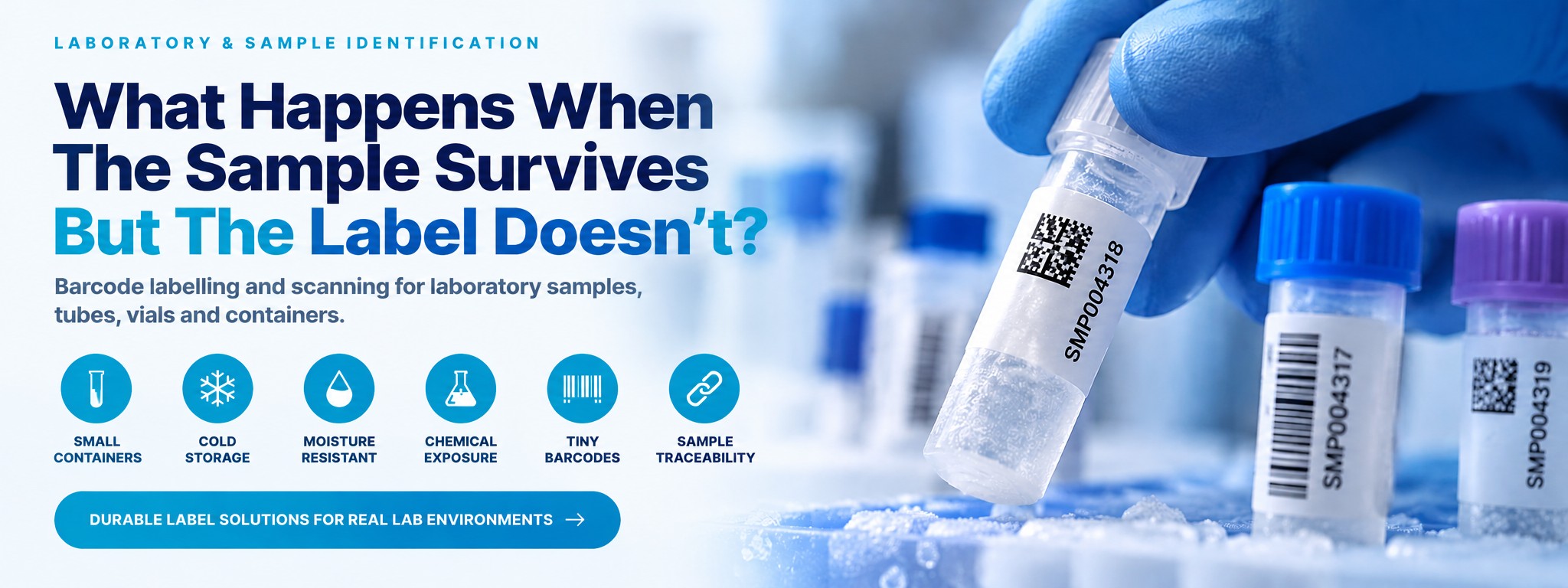
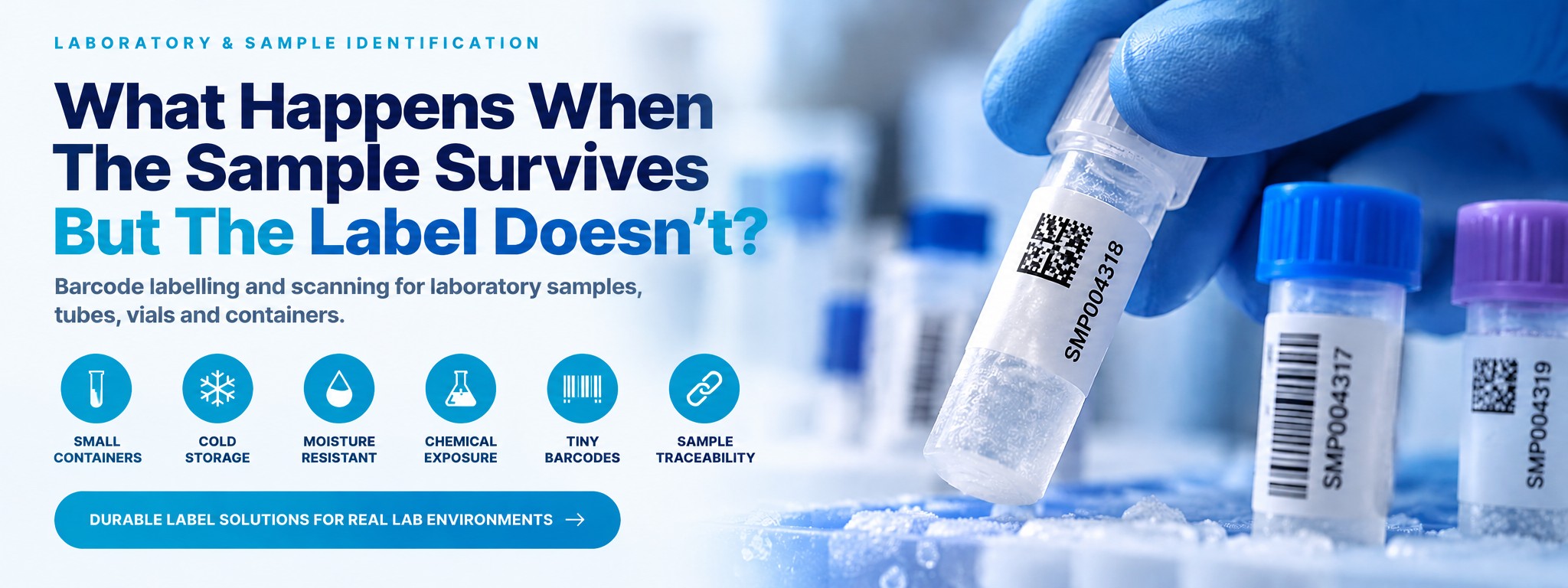
Laboratories • Samples • Tubes • Vials • Traceability
What Happens When the Sample Survives but the Label Doesn't?
Laboratory identification can ask a lot from a very small label.
It may need to fit onto a tube, vial, bottle or other small container, carry enough information to identify the sample and remain readable throughout storage, handling and testing.
Add moisture, cold storage, chemicals or a very small barcode and an ordinary labelling setup may no longer be enough.
The Label Is Part of the Sample-Identification Process
A sample can be perfectly intact while its identification has become damaged, detached or unreadable.
That's why laboratory labelling needs to be considered around the complete lifecycle of the sample, rather than simply whether the label looks good when it first comes out of the printer.
A Small Label Can Carry a Big Responsibility
If the barcode cannot be scanned or the human-readable information can no longer be read, identifying the physical sample can become much more difficult.
What Does the Sample Label Have to Deal With?
Small Containers
Tubes and vials can provide very limited space for a barcode and human-readable information.
Cold Storage
Samples may be stored in refrigerators, freezers or other temperature-controlled environments.
Moisture
Condensation, wet handling and other moisture exposure can affect unsuitable label materials.
Chemicals
Some laboratory workflows expose labels to chemicals, cleaning agents, solvents or other substances.
Handling
Small containers may be handled repeatedly during preparation, analysis, storage and retrieval.
Long-Term Storage
Some samples may need to remain identifiable long after the label was originally printed.
Start With the Container
Before choosing the printer or label, look at what the label actually needs to attach to.
Tubes
Small diameter and curved surfaces can restrict both label dimensions and the amount of printable information.
Vials
Compact containers may require small labels while still leaving important areas of the vial visible.
Bottles & Containers
Larger sample containers provide more labelling space, but surface material and storage conditions still matter.
Slides
Very limited identification areas can create a different labelling and barcode-size challenge.
Bags & Sample Packs
Flexible packaging can require different media and adhesive considerations from rigid containers.
Boxes & Racks
Secondary identification can also be used on storage boxes, racks and other sample-management locations.
How Much Label Space Do You Actually Have?
In laboratory applications, the available label area can be surprisingly small.
That affects both what can be printed and how easily any barcode can be captured.
Measure the Available Area
Send us the approximate width and height available for the label, together with the dimensions of the tube, vial or container.
That gives us a much better starting point than simply asking for a “laboratory label printer”.
Small Label = Small Barcode
When the available print area shrinks, the barcode may also need to become smaller.
That can introduce a second problem: the label prints perfectly, but the scanner being used isn't designed to resolve a very small, high-density code.
1D Barcodes
Traditional linear barcodes may require enough physical width to maintain suitable bar and space dimensions.
2D Codes
Data Matrix and other 2D codes can encode information within a compact area, but very small modules may require appropriate high-density scanning capability.
The Printing Method Matters Too
The appropriate printing technology depends on the required label lifespan and the environment the sample will experience.
Direct Thermal
Direct thermal printing creates the image on heat-sensitive media without using a ribbon.
It can be appropriate for suitable shorter-life identification applications where the media and environment match the requirement.
Thermal Transfer
Thermal-transfer printing uses a ribbon to create the printed image on compatible label media.
It can provide a useful starting point for applications requiring more durable identification, provided the media and ribbon are suitable for the actual environment.
Will the Samples Be Refrigerated or Frozen?
Cold storage needs to be considered before the label material and adhesive are selected.
Tell us both the storage temperature and the conditions in which the label will actually be applied.
Freezer and Cryogenic Applications Need Specific Checking
Don't assume that a label described simply as “freezer” or “laboratory” media is suitable for every low-temperature application.
For very low-temperature or cryogenic storage, the exact media, adhesive and manufacturer specification should be checked against the required temperature and application conditions.
Will the Label Come Into Contact With Chemicals?
If labels may encounter solvents, reagents, cleaning agents or other chemicals, tell us exactly what substances are involved.
Different materials and printed images can react differently to different chemicals.
“Chemical Resistant” Isn't Specific Enough
The useful information is the actual chemical or cleaning product, expected exposure and required label lifespan.
That allows the proposed media and ribbon to be checked against the real application rather than relying on a generic durability description.
Where Can Sample Labelling Become Important?
Environmental Testing
Identify water, soil and other environmental samples through receipt, analysis and storage.
Food Testing
Track samples through laboratory testing and associated storage workflows.
Biotechnology
Identify tubes, vials and other laboratory containers across research workflows.
Materials Testing
Maintain identification of specimens and samples through preparation, testing and storage.
Veterinary Diagnostics
Support machine-readable identification of suitable diagnostic samples and containers.
Industrial Laboratories
Identify production, quality-control and engineering samples throughout testing processes.
Identification Has to Follow the Sample
The label is the physical connection between the sample in front of you and the information held about it elsewhere.
A machine-readable identifier can support sample identification at the important stages of the laboratory workflow.
Sample Receipt
Identify incoming samples and associate them with the appropriate laboratory workflow.
Preparation
Maintain identification as samples are prepared, divided or moved into different containers.
Analysis
Capture the sample identifier during suitable testing and analytical processes.
Storage
Keep samples identifiable while they are refrigerated, frozen or stored under other laboratory conditions.
Retrieval
Scan stored samples when they are retrieved for further work, testing or review.
Archive or Disposal
Maintain identification through the later stages of the sample lifecycle where required by the workflow.
Can Your Scanner Read the Finished Label?
Printing a small barcode successfully is only half of the identification problem.
The scanner also needs to capture it reliably at a practical working distance.
General-Purpose Scanning
If the sample label provides enough space for a normal-sized barcode, a suitable general-purpose scanner may be all that's required.
High-Density Scanning
Very small barcodes or Data Matrix codes can require a scanner configuration designed to resolve finer elements at close range.
Test the Smallest Barcode
Don't test only the easiest label in the laboratory. If one sample type requires a particularly small barcode, include that code when evaluating the scanner.
Printer and Scanner Need to Work Together
Laboratory identification can involve two separate hardware decisions that are closely connected.
Printing
The printer needs to produce the required label dimensions and barcode quality using media appropriate for the sample environment.
- Required label dimensions
- Print resolution
- Direct thermal or thermal transfer
- Compatible media
- Required print volume
Scanning
The scanner needs to capture the finished code reliably within the actual laboratory workflow.
- Barcode symbology
- Code dimensions
- Module or X-dimension
- Working distance
- Required connectivity
Send Us the Container Dimensions
You don't need to know which printer, label material or scanner configuration you need.
Start by giving us the details of the sample and its environment.
1. Container
Tell us whether you're labelling a tube, vial, bottle, slide, bag or another type of sample container.
2. Dimensions
Give us the approximate dimensions of the container and the available area for the label.
3. Storage Temperature
Tell us whether samples are kept at room temperature, refrigerated, frozen or under another specified condition.
4. Chemical Exposure
Tell us about any solvents, reagents, cleaning products or other substances that may contact the label.
5. Required Lifespan
Does the label need to remain readable for hours, days, months or potentially much longer?
6. Label Quantity
Approximately how many sample labels need to be produced during a typical day, week or batch?
7. Barcode Type
If known, tell us whether you need a 1D barcode, Data Matrix, QR code or another machine-readable format.
8. Existing Equipment
If you're replacing an existing printer or scanner, send us the model and explain what's not working.
Questions Worth Asking Before Choosing the Hardware
- What is the smallest container that needs a label?
- What is the maximum usable label area?
- How small will the finished barcode be?
- How long must the identification remain readable?
- At what temperature will samples be stored?
- At what temperature will labels be applied?
- Will condensation or moisture be present?
- Will labels come into contact with chemicals or solvents?
- How frequently will the container be handled?
- How many labels are printed in a typical batch?
- Does the scanner need to read other barcode sizes too?
- What system receives the scanned sample identifier?
Test the Actual Sample, Not Just a Specification Sheet
For demanding laboratory applications, representative testing is particularly important.
Actual Container
Apply the proposed label to the same type and size of tube, vial or container used in the laboratory.
Actual Environment
Where practical, test the label under representative storage, moisture and handling conditions.
Actual Barcode
Print the real barcode dimensions and data rather than testing only with a larger demonstration code.
Actual Scanner
Confirm that the proposed scanner captures the finished barcode reliably at a usable working distance.
Actual Chemical Exposure
Where chemical resistance is required, check the proposed media against the substances involved in the real process.
Actual Workflow
Make sure printing and scanning fit naturally into the way laboratory staff actually handle samples.
Hardware for Laboratory Sample Identification
The right setup depends on the container, label dimensions, barcode size, required lifespan and environment.
These are useful starting points for different laboratory identification requirements.
TSC TX610
A specialist 600 dpi desktop label printer for applications requiring very fine print definition.
- Very small labels
- Fine text
- Compact barcodes
- Detailed identification labels
- Desktop laboratory workflows
Zebra ZD621
A premium desktop label-printer family for professional identification and barcode-printing applications.
- Desktop label printing
- Laboratory identification
- Barcode labels
- Different configurations available
- Compact professional printer
Zebra DS8108-HC
Healthcare-focused 1D/2D barcode scanner suitable for specimen tracking and laboratory scanning workflows.
- 1D & 2D barcode capture
- Healthcare-focused housing
- Specimen tracking
- Laboratory workflows
- Fixed workstation scanning
The Label Media Matters as Much as the Printer
Laboratory applications can place very different demands on label material, adhesive and printed-image durability.
Tell us the container material, label dimensions, storage temperature, chemical exposure and required lifespan and we can help narrow down the type of media and ribbon that should be investigated.
Freezer, Cryogenic or Chemical Exposure?
These applications require the exact label media and ribbon specification to be checked against the real conditions. We won't assume that a general laboratory label is suitable simply because it fits the printer.
Send Us the Container. Start From There.
If you're trying to label a small tube, vial or sample container, you don't need to work through hundreds of printer and media specifications yourself.
Send us the container dimensions, available label area, storage temperature, required lifespan and approximate number of labels.
If you already have a sample label, send us a photo of that too.
Discuss Your Sample LabellingWhat Problem Are You Actually Trying to Solve?
“The Label Falls Off”
Start with the container surface, application conditions, storage environment and adhesive requirement.
“The Print Becomes Unreadable”
Look at the printing method, media, ribbon and environmental exposure.
“The Barcode Is Too Small to Scan”
Look at the code dimensions, print quality and scanner optics.
“We Need Smaller Labels”
Start with the available print area, required information and minimum barcode dimensions.
“The Labels Get Wet”
Consider the media, adhesive and complete exposure conditions rather than only the printer.
“They're Going in a Freezer”
Check the exact storage temperature, application conditions and manufacturer specification for the proposed media.
Is the Barcode Itself the Problem?
If your labels are fine but the scanner struggles because the barcode or Data Matrix code is extremely small, the problem may be the scanning configuration rather than the labelling system.
Already Know What You Need?
If you've already identified the printer, scanner, label media, ribbon or other hardware required, send us the manufacturer part number and quantity and we'll provide another business price to compare.
Small Sample. Small Label. Big Identification Problem.
Tell us what you're labelling and what the finished label needs to survive.
We'll help narrow down the printing, media and scanning hardware worth considering for the application.
Help Me Choose a Labelling SetupImportant: laboratory label suitability depends on the complete application, including container material, surface, label dimensions, adhesive, printing method, ribbon, storage temperature, application temperature, moisture, chemical exposure and required lifespan.
Freezer, cryogenic and chemical-resistant applications can have highly specific requirements. Suitability should be confirmed against the specification of the exact label media, ribbon and other consumables being supplied.
For demanding applications, testing representative containers, labels, environmental conditions and scanners before a larger deployment is recommended.